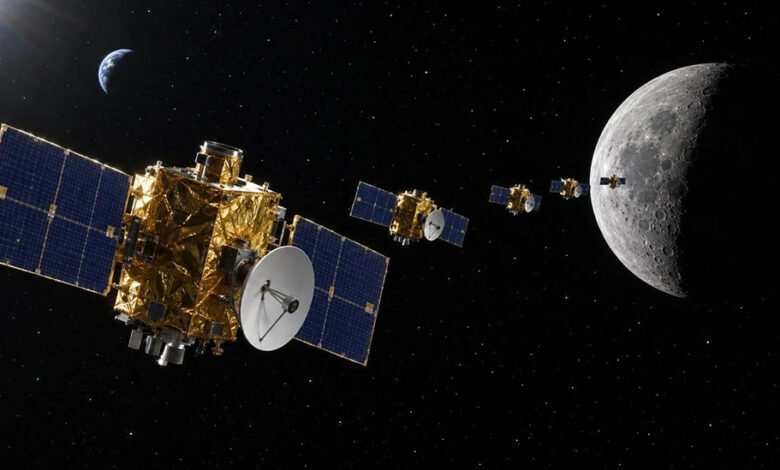
The Department of the Air Force and the U.S. Space Force are preparing to buy up to five cislunar satellites, with the aim of establishing an operational defense presence between Earth and the Moon by late 2029, according to an industry notice. The formal Request for Information (RFI) is the military’s first procurement step toward treating deep space beyond geostationary orbit (GEO) as an active warfighting domain.
Monitoring a Much Larger Volume
The notice cites strategic concern over cislunar space, which it describes as an operational volume 1,728 times larger than traditional GEO. Foreign adversaries are expanding their lunar exploration efforts, and defense planners want to track deep-space trajectories and be able to counter potential threats there.
The effort follows earlier Space Force work, including the service’s formalization of a cislunar strategy amid an acquisition restructuring aimed at threats beyond GEO. It also aligns with the 2040 blueprint that Gen. Chance Saltzman unveiled to scale the Space Force for great power competition.
Seed Vehicles, Not a Full Constellation
The planned satellites are meant to serve as seed vehicles. Their job is to test operational survivability before the military commits to a larger proliferated constellation.
To avoid the four- to five-year development cycles typical of such programs, the service is prioritizing commercially available spacecraft buses that can be integrated for flight quickly. The approach draws on deep-space technologies matured under the Air Force Research Laboratory’s Oracle cislunar space situational awareness program, moving experimental concepts toward operational hardware.
Payload and Autonomy Requirements
Under the Cislunar Space System (CSS) notice, contractor-provided platforms must host government payloads. These support space domain awareness (SDA), data relay, and independent positioning, navigation, and timing (PNT).
Buses must either have flight heritage within the past three years or complete qualification within 24 months. They must also carry autonomous software able to handle station-keeping and fault recovery for at least 72 hours without ground contact.
Schedule
Responses to the RFI are due Nov. 24, 2026. The Department of the Air Force intends to award up to five firm-fixed-price preliminary design study contracts in early 2027. The acquisition schedule targets initial launch capability by late 2029 and full on-orbit operations by 2031.
The notice describes plans and intentions rather than awarded contracts, and the number of satellites and the timeline could change as the process moves forward.
Source: satnews.com