Skywatchers in mid-northern latitudes have a busy stretch ahead from November 6 to 15, 2026. The main event is a close pairing of Mars and Jupiter in the predawn sky, with a conjunction on the morning of November 16. Mercury is also returning to the dawn sky near Venus, and the Moon reaches new phase on November 9, which leaves the evening sky dark for deep-sky observing.
Dawn planets: Mars, Jupiter, Mercury and Venus
Mars (magnitude +0.8) and Jupiter (magnitude –2.1) rise in the east-northeast around 11 p.m. or midnight, only about 10 minutes apart, with Mars first. Regulus, the 1.4-magnitude lead star of Leo, follows about half an hour behind Jupiter. By the start of dawn all three stand very high in the southeast. At conjunction on November 16, the two planets will be 1.2° apart.
Neither planet is a rewarding telescope target at the moment. Mars spans only about 7 arcseconds, and Jupiter, at 36 arcseconds, is small by its own standards.
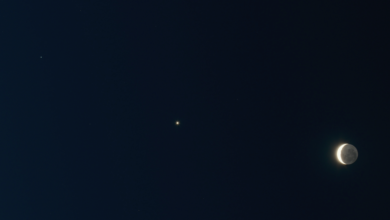
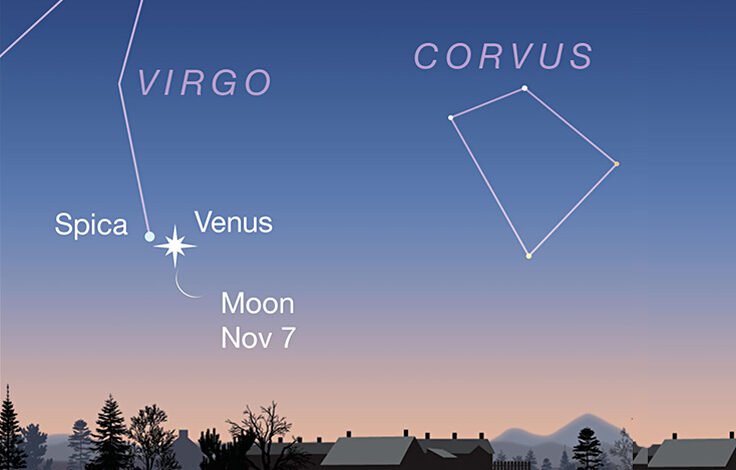
Lower in the east-southeast, Venus (magnitude –4.5) is climbing and gaining prominence as the Morning Star. It sits within 1.4° of Spica all week because it is near its stationary point in longitude against the stars, so the two fit in one binocular field. On the morning of November 7, a very thin waning crescent Moon, two days from new, joins them within about 2° of Venus. Binoculars help against the brightening sky.
Mercury emerges from the Sun’s glare during the week. Around November 12 it should appear roughly a fist at arm’s length to the lower left of Venus, still dim at magnitude +0.8. Three days later it will be higher and more than twice as bright, at magnitude –0.1, with the two inner planets a little more than a fist apart on the morning of the 15th.
Evening targets: Saturn, Uranus and Neptune
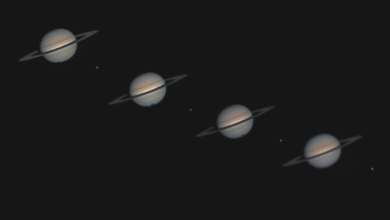
Saturn (magnitude +0.5, in Cetus below the Great Square of Pegasus) is a month past opposition. It is the first point of light to appear in the east-southeast as twilight fades and crosses the meridian around 9 or 10 p.m. Fomalhaut, fainter at magnitude 1.2 and twinklier, lies three or four fists to its lower right. Saturn’s ring spokes are in a season of activity, and imager Christopher Go recorded them changing within two nights in late October.
Uranus (magnitude 5.6) lies in Taurus between the Pleiades and Aldebaran and is visible in most binoculars with a good finder chart. Neptune (magnitude 7.8, in Pisces) is about 7° west of Saturn. Observers with a telescope of 8 to 12 inches can try for Neptune’s moon Triton, at magnitude 13.6.
Stars and constellations
Algol dims to its minimum, about magnitude 3.4, for roughly two hours around 10:34 p.m. EST on November 6, and again around 7:23 p.m. EST on November 9. New Moon occurs at 2:02 a.m. EST on the 9th.
On November 15, Lyra offers several double stars near Vega. Epsilon Lyrae, the Double-Double, splits in binoculars, and a 4-inch telescope at 100× or more can separate each component into a tight pair in good seeing. Zeta Lyrae is a tougher binocular double but is plainly resolved in a telescope. Delta Lyrae is a wider orange-and-blue pair.
The “Summer” Triangle of Deneb, Vega and Altair still stands high after dark in November. Earlier sunsets offset the seasonal westward drift of the stars, so these stars appear to hold their positions at nightfall.
Descriptions assume mid-northern latitudes, and Moon positions are for North America.
Source: skyandtelescope.org