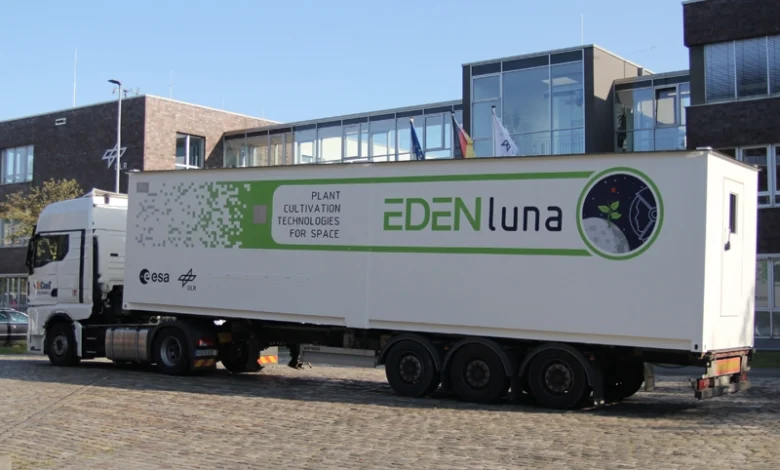
A fire at an external contractor’s facility has pushed back the installation of EDEN-LUNA, a containerised greenhouse designed to test crop cultivation for future Moon missions, to the second quarter of 2027. The German Aerospace Center (DLR) had originally expected to complete the work at the LUNA facility in Cologne in 2026.
The cause of the delay emerged in the German government’s response to a parliamentary inquiry, published by the Bundestag on 20 October. According to that response, the fire broke out while the greenhouse container was undergoing refurbishment. The document does not say how extensive the damage was or which components were affected.
A delay acknowledged without explanation
DLR had already said in a statement on 4 September that installation would not happen until 2027, but it gave no reason at the time. The explanation came only after members of the Alternative for Germany (AfD) party submitted the parliamentary inquiry.
From Antarctica to a lunar analogue
EDEN-LUNA is DLR’s effort to study technologies for producing fresh food during long-duration missions to the Moon and Mars. It builds on the agency’s EDEN ISS greenhouse, which operated near Germany’s Neumayer III research station in Antarctica from 2018 to 2022.
After the Antarctic campaign ended, the greenhouse was dismantled and shipped back to Germany in April 2023. DLR has since been refurbishing and upgrading it at the Institute of Space Systems in Bremen, in preparation for a second experimental campaign under the EDEN-LUNA programme.
The upgraded facility is to include robotic assistance, automated plant monitoring and systems intended to recover nutrients from waste products.
The LUNA facility
The greenhouse is due to be installed at LUNA, which DLR operates jointly with the European Space Agency. The facility was inaugurated in September 2024 and has about 700 square metres of simulated lunar terrain. It is used to test technologies and to train astronauts for future lunar missions.
Source: europeanspaceflight.com