Debris disk star Beta Piscis Austrinus spins rapidly and is viewed nearly pole-on


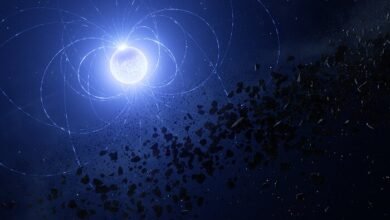
The nearby A-type star Beta Piscis Austrini (β PsA) spins at about 93% of its break-up speed, even though its spectrum suggests a slow rotator. A new spectroscopic analysis explains the discrepancy: we see the star almost exactly pole-on. The study, reported in The Astrophysical Journal, puts the star’s inclination at roughly 4.75 degrees. It also shows that ignoring rapid rotation leads to a considerable overestimate of the star’s age.
A fast spinner that looks slow
β PsA is a bright (V = 4.29) A1V star about 45 parsecs away, with a measured projected rotational velocity (v sin i) of 26 km/s. The new model finds an equatorial velocity of 314 km/s. Rapid rotation flattens the star to an oblateness (equatorial radius divided by polar radius) of 1.26 and cools its equator through gravity darkening. The equator sits at 8,275 K, about 2,025 K cooler than the 10,300 K poles.
The team used 22 archival HARPS spectra from the ESO 3.6 m telescope at La Silla, stacked to a signal-to-noise ratio of about 980. They modeled 11 temperature-sensitive metallic lines whose profiles develop a “saddle” shape at the line center when a gravity-darkened star is seen pole-on. The same distortion was first noted in Vega, the prototype for this effect. Six pairs of iron lines helped fix the absolute polar temperature, because line shapes alone cannot separate a hot, nearly pole-on star from a cooler, more inclined one. The synthetic spectra came from the fastrot-spec code.
Luminosity, mass and age revised
Because a pole-on view favors the hotter polar regions, standard methods overstate the star’s output. The best-fit model gives a luminosity 48% below the 38.6 solar luminosities previously reported by Zorec and Royer in 2012. Comparing the revised luminosity and mean-radius effective temperature with PARSEC rotating evolutionary tracks yields a mass of 2.20 ± 0.03 solar masses and an age of 141 million years. This agrees with an earlier estimate of 180 ± 90 million years.
Using the earlier apparent values with the same models gives a mass 5% higher and an age of 371 million years, 163% older. The authors say this shows why rotation matters even for stars that look like slow rotators.
The model was checked against International Ultraviolet Explorer spectra, which it matched closely, and against a lower-resolution CHIRON spectrum from the SMARTS 1.5 m telescope, which gave consistent properties. Applied to Vega, the method recovered an inclination and polar temperature consistent with published values.
Companion star supports the age
β PsA has a common proper motion companion, the G5V star CD-32 17127, at a projected separation of 1,373 au. A CHIRON spectrum of the companion shows strong lithium absorption, an indicator of youth, with an equivalent width of 102.4 ± 1.1 mÅ at 6708 Å. With an effective temperature of 5,964 ± 110 K, the lithium-depletion models give an age consistent within 1σ with that of β PsA.
The star also hosts a debris disk, detected through far-infrared excess in the Herschel DEBRIS survey and modeled as extending to 60 ± 30 au. The disk is unresolved, so its inclination is unknown.
Implications for wider surveys
The authors argue that spectroscopy alone can test assumptions in rapidly rotating star models, such as gravity-darkening laws, which have usually been probed with interferometry. Since the method worked on data from a 1.5 m telescope, they suggest applying it to samples of low-v sin i A stars to separate truly slow rotators from nearly pole-on fast ones. Assuming low obliquity, such stars could also point to face-on debris disks and planetary systems, which are the hardest to identify but among the best for studying how planets sculpt their disks.
Source: doi.org