


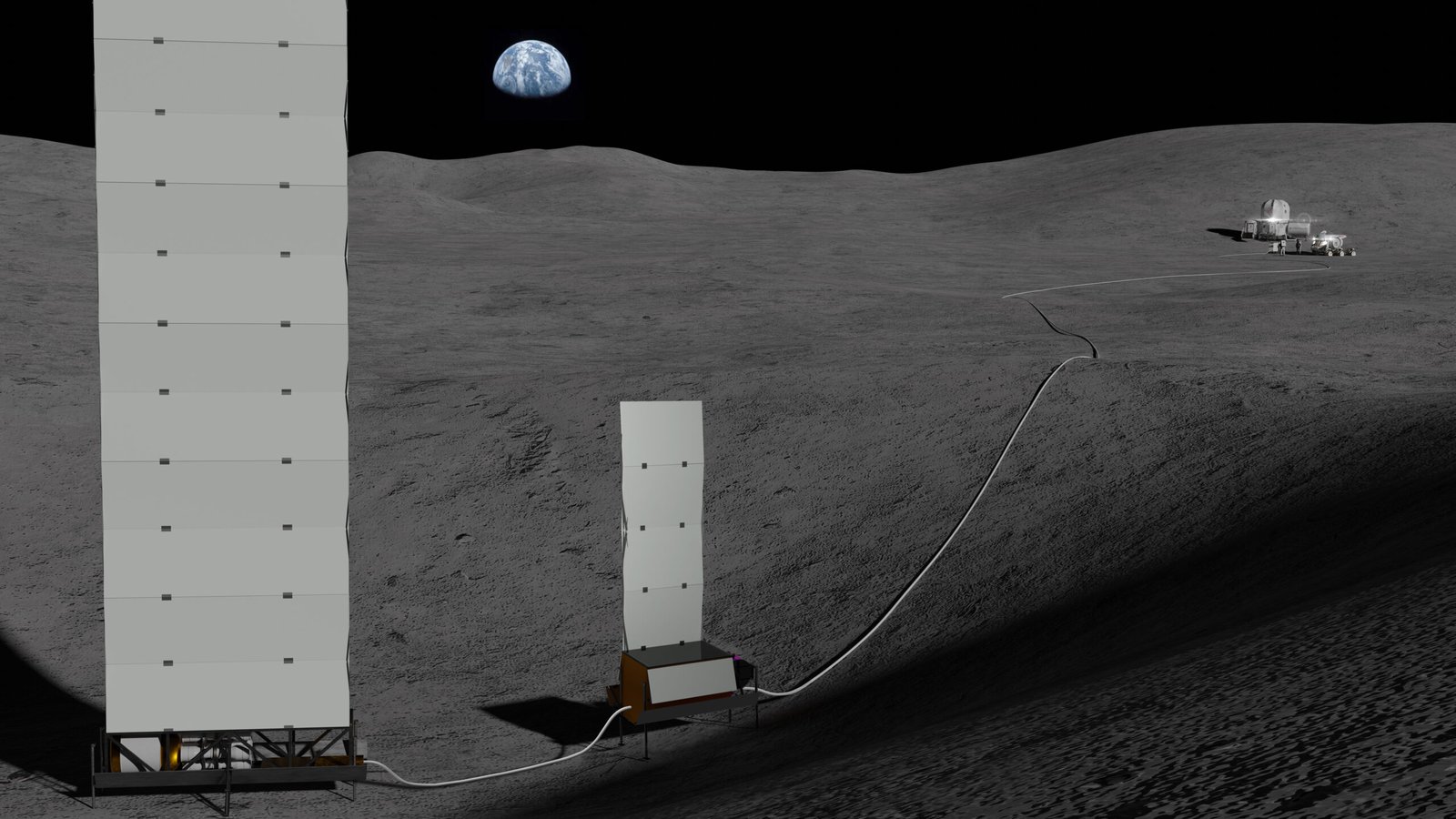
NASA has opened a competition for industry partners to develop and test Lunar Reactor-1 (LR-1), a fission power system that would be the first nuclear reactor built to supply electricity on the Moon. The agency describes the project as part of its plan for a Moon Base and a sustained human presence on the lunar surface.
LR-1 is designed as a small reactor producing 20 kilowatts of electricity. NASA compares that to the annual consumption of roughly 16 average U.S. households. On the Moon, the agency says, the output could support habitats, communications systems, rovers, scientific instruments and other infrastructure. NASA’s goal is a launch-ready system by 2030 that then operates on the lunar surface for at least five years after deployment.
Power through the lunar night
The main advantage over solar power is continuity. A lunar night lasts about 14 Earth days, and solar arrays cannot produce electricity during that time. A reactor does not depend on sunlight, so it could also serve locations where light is limited or absent. Brian Giblin, NASA’s LR-1 program manager, said the request for proposals is a step toward partnering with industry on a lasting lunar presence. He added that space nuclear systems can provide continuous power in any environment.
The same logic applies beyond the Moon. NASA notes that dust storms on Mars can block sunlight for months, and that solar power becomes steadily less effective farther from the Sun.
Details of the solicitation
The Space Power and Reactor Capabilities Request for Proposals reflects feedback gathered after NASA released a draft in August and held an industry day in September at the Ohio Aerospace Institute in Cleveland. Under the solicitation, the reactor must meet Department of Energy (DOE) safety standards for nuclear operations. Proposals are due Dec. 21.
The primary aim is to advance the technology, testing and flight design of LR-1. NASA may also issue additional task orders to support other space nuclear power systems.
Part of a wider reactor program
LR-1 is managed by NASA’s Space Reactors Division in partnership with the DOE. The same division is responsible for Space Reactor-1 (SR-1) Freedom, scheduled to launch in 2028. That mission is to deliver three SkyFall helicopters to Mars and demonstrate nuclear electric propulsion, in which electricity from a reactor powers a spacecraft’s propulsion system. NASA says the technology could allow future spacecraft to travel farther and carry out deep space missions not possible with conventional propulsion.
NASA and the DOE present the two projects together as a push to advance space nuclear power and propulsion, and as a way to support U.S. leadership in space.
Source: www.nasa.gov