


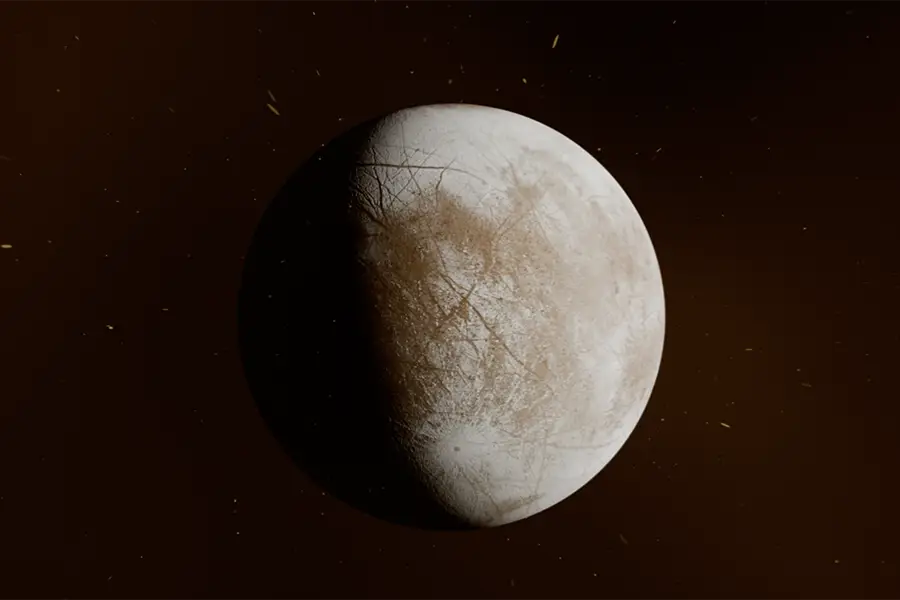
Sodium surrounding Jupiter’s moon Europa appears to originate from the moon itself, not from volcanic neighbor Io. That is the conclusion of a team that analyzed eight years of Keck Observatory data and found that the sodium cloud stays steady even when Io’s activity surges. The most likely local source is Europa’s subsurface ocean.
The results were published in JGR: Space Physics. Emma Lovett, a graduate student at Boston University, is first author. Carl Schmidt of Boston University and Queen’s University Belfast is a coauthor.
Settling an old question
Europa is thought to hide an ocean beneath kilometers of ice, possibly larger than Earth’s oceans. Its composition is poorly known, though magnetic measurements indicate it is probably salty. Sodium is half of table salt (sodium chloride), and researchers have known since the 1990s that the element is present around Europa. What remained unclear was where it came from.
Io is the most volcanically active body in the solar system, and its eruptions release gases, sodium among them, that spread through the Jovian system. One idea held that material from Io was reaching Europa and effectively coating it with sodium, Schmidt explains.
The Keck data, combined with archival observations, did not fit that picture. The sodium content of Europa’s exosphere was remarkably constant, even during periods of enhanced volcanic activity on Io. A steady supply points to a local source. Schmidt says the team had suspected the ocean for some time and can now state the conclusion with confidence.
From ocean to exosphere
The salt probably does not travel straight from ocean to atmosphere. Europa’s ice shell averages tens of kilometers thick, leaving no direct path. Instead, pockets of briny water may eventually reach the surface and deposit salts on the ice. Charged particles in Jupiter’s plasma-rich environment then knock those salts loose and eject them into space, a process called sputtering.
Sodium is a convenient tracer because it glows brightly in sunlight and can be observed from the ground with a high-resolution spectrograph, such as those on the Keck telescopes. Its behavior offers a window into the whole exosphere and, indirectly, the chemistry of the ocean below.
The observations were difficult. Europa’s icy surface is highly reflective, which makes it hard to separate sodium emission from reflected sunlight, Lovett notes. Most measurements were therefore limited to about 6,000 kilometers (4,000 miles) above the surface. Within that range, the researchers expected variation as Europa moves around Jupiter and through its magnetosphere, but saw none. Schmidt was surprised by how uniform and structureless the atmosphere appeared, in contrast to the tenuous atmospheres of Mercury and Earth’s Moon, which proved more dynamic than expected.
Limits for habitability
Europa is one of few places beyond Earth that may combine liquid water, organic chemistry, and an energy source, in this case geological activity driven by Jupiter’s tidal pull. Still, the finding does not settle whether the sodium comes from the ice shell, essentially frozen ocean water, or more directly from the ocean. Planetary scientist Paul Byrne of Washington University in St. Louis says no one knows. He called the result robust but said it does not generally advance understanding of Europa’s habitability, though any information about its interior is valuable.
The team plans Hubble Space Telescope observations to search for magnesium, likely another of the salts dissolved in the ocean. Schmidt describes the work as preparation for NASA’s Europa Clipper and ESA’s Jupiter Icy Moons Explorer (JUICE), both due to reach the Jovian system within the next decade. The aim is to help mission teams choose wavelengths and locations where interesting activity is expected.
Source: skyandtelescope.org