


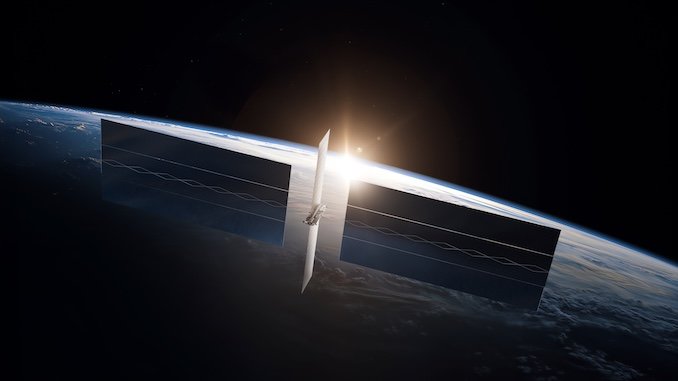
The Federal Communications Commission has authorized SpaceX to build and operate Starmind, a constellation of up to 1 million satellites intended to serve as orbital data centers. The order was published the day before Thanksgiving. It comes roughly a year after Elon Musk began publicly discussing the benefits of moving computing infrastructure off the ground. SpaceX filed its application on Jan. 30, 2026.
Deployment deadlines
Under the license, SpaceX must launch its first Starmind satellite by Nov. 25, 2033. Half of the constellation must be in orbit by Nov. 25, 2038, and the full fleet by Nov. 25, 2040. Musk said during a talk hosted by Baron Capital that he expects the first launch in the third quarter of 2027, with production ramping to significant volume in 2028 and very large volume in 2029. SpaceX is building the spacecraft in partnership with Nvidia.
For scale, SpaceX’s Starlink network has nearly 11,200 satellites in orbit, according to tracking data kept by astronomer Jonathan McDowell.
Design and orbits
The FCC order places the satellites in orbital shells, each 50 km thick, at altitudes between 500 and 1,002 km. The shells use 30-degree and sun-synchronous inclinations. SpaceX’s website lists each satellite with a 75-meter (246 ft) wingspan and a deployed height of 30 meters (98 ft).
Michael Nicholls, SpaceX’s senior vice president of Starlink and AI, outlined the architecture at the International Astronautical Congress in October. Clusters of satellites would fly in tight formation to deliver enough coherent computing power to run AI models efficiently. He said each satellite might draw about 250 kilowatts, roughly equivalent to one rack of Nvidia NVL72 hardware. A cluster of about ten satellites would be linked at roughly 10 terabits of bandwidth and connected to the wider constellation and to Starlink.
The constellation will communicate over optical links. The FCC also allowed SpaceX to use Ka-band frequencies for telemetry, tracking and command, but only if the optical links fail. The agency said this restriction resolves radiofrequency interference concerns raised by Viasat, Amazon Leo and the American Astronomical Society (AAS), and it rejected their petitions to deny.
Astronomers object
The AAS said it was disheartened by the decision. It voiced concern about the future of federally funded astronomy under an altered night sky and about the possible waste of taxpayer money invested in observing facilities. The society noted that the license contains no formal requirement to coordinate with the National Science Foundation. It also argued that the FCC should weigh the protection of optical and infrared astronomy because no other licensing agency can do so.
The FCC said SpaceX’s application and supplemental material had adequately addressed optical astronomy concerns. It added that the AAS’s points concern non-spectrum impacts outside the scope of its review of the radiofrequency operations.
Debris and disposal questions
On orbital debris, the FCC noted that SpaceX will deploy satellites at lower altitudes first and test them before raising them to higher, longer-lived orbits. The satellites’ propulsion will handle orbit raising, station-keeping and disposal while still allowing collision-avoidance maneuvers.
Nicholls said the constellation’s size demands significantly greater reliability. He pointed to close-formation operations, micrometeoroid debris and end-of-life planning as open challenges. He suggested that Starmind satellites might be sent to heliocentric or graveyard orbits rather than reentered into the atmosphere.
The FCC deferred SpaceX’s request to dispose of satellites in heliocentric orbits, which would apply to those operating above 600 km. It said SpaceX had not supplied enough information to show the alternative methods meet commission requirements. Before deploying any Starmind satellite that will not be disposed of by atmospheric reentry, SpaceX must file a modification application justifying any waivers.
Launch and manufacturing
SpaceX plans to launch Starmind satellites on Starship-Super Heavy, as it does with Starlink V3. The company has completed two orbital Starship flights and has deployed 52 Starlink V3 satellites with the vehicle. Starmind satellites will be built in Bastrop, Texas, about 350 miles north of Starbase, where Starship launches.
FCC Chairman Brendan Carr framed the approval as support for U.S. leadership in artificial intelligence. Musk thanked him on X and called the license a great asset to America and the world.
Source: spaceflightnow.com