


Skywatchers in the mid-northern latitudes have a busy stretch ahead from November 27 to December 6, 2026. The Moon passes a cluster of morning planets, Algol dims on schedule, Venus holds its peak brightness, and the Geminid meteor shower is about a week from its maximum. Most of it needs no more than the naked eye or binoculars.
Moon and Morning Sky
On the evening of November 27, the waning gibbous Moon rises around 8 p.m. local time and lines up with Pollux and Castor above it. Late that night, a telescope shows the lunar sunset terminator, where sunlight strikes familiar features from the opposite direction than during the waxing phases. At midnight EST, Hercules crater lies in shadow in the far north, while Janssen in the south is still fully lit. The twin craters Fabricius and Metius on its northern edge are already filling with shadow.
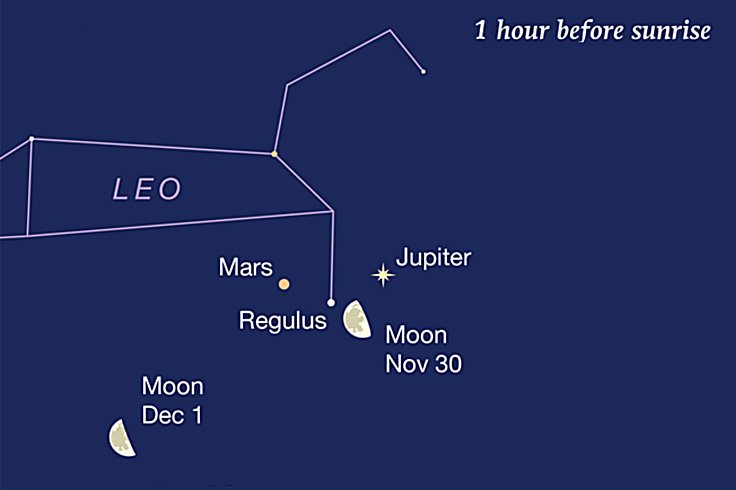
In the early hours of Monday, November 30, the Moon joins Jupiter, Mars and Regulus high in the sky before dawn. The four fit within a circle about 6° wide as seen from the Americas, roughly the field of view of typical binoculars. The Moon reaches last quarter at 1:09 a.m. EST on December 1. By that morning it sits about a fist-width below the group, in the feet of Leo.
Lower in the southeast, Venus, Mercury and Spica continue to drift apart. Venus is at magnitude –4.9, its greatest brilliance, and appears 22° from Mercury on November 28 and 28° away by December 5. Mercury shines at magnitude –0.6 and is sinking lower each day. A telescope shows Venus as a thickening crescent about 37 arcseconds wide and 30% sunlit. Mercury’s disk is about 5½ arcseconds across and 90% sunlit.
Evening Targets
On November 29, Algol falls to its minimum, magnitude 3.4 instead of its usual 2.1, for a couple of hours centered on 9:06 p.m. EST. Nearby, the Andromeda Galaxy (M31) and the Perseus Double Cluster are both cataloged at 4th magnitude and sit about 22° apart. Under reasonably dark skies each can be seen without optics, though M31 is slightly harder. On December 3, M31 crosses the zenith around 8 p.m. for observers near 41° north latitude, such as Denver, New York and Madrid.
For a harder binocular challenge, the sparse cluster Collinder 463 in Cassiopeia is nearly 1° long, with stars of only 8th and 9th magnitude. It lies 8° north of Epsilon Cassiopeiae and is best hunted on the moonless nights around December 5.
Geminids Ahead
The Geminid meteor shower, often the year’s strongest, peaks late on the night of December 13–14. A waxing crescent Moon sets around 9 p.m. that evening, leaving dark skies until dawn. The radiant lies near Castor and climbs through the night, passing near the zenith around 2 a.m., when rates are highest.
Planets This Week
Jupiter (magnitude –2.2) and Mars (+0.5) rise in the east-northeast around 10 or 11 p.m., with Regulus between them. Jupiter appears 39 arcseconds wide in a telescope, and Mars is about 8 arcseconds and gibbous. Both are growing. Jupiter reaches opposition on the night of February 10 and Mars on February 19.
Saturn (magnitude +0.7, in Cetus) crosses the meridian around 8 p.m. Christopher Go’s images from October 26 and 28 show ring spokes changing within two nights, a phenomenon that appears during certain seasons of Saturn’s 29.5-year orbit. Uranus (magnitude 5.6, in Taurus) sits 6° southeast of the Pleiades. Neptune (magnitude 7.9) lies 6° west of Saturn, near the Circlet of Pisces. A 10- or 12-inch telescope at high power can reach Uranus’s moons Titania and Oberon, at about magnitude 13.5 and 13.7, and Neptune’s moon Triton, at about magnitude 13.6.
Source: skyandtelescope.org