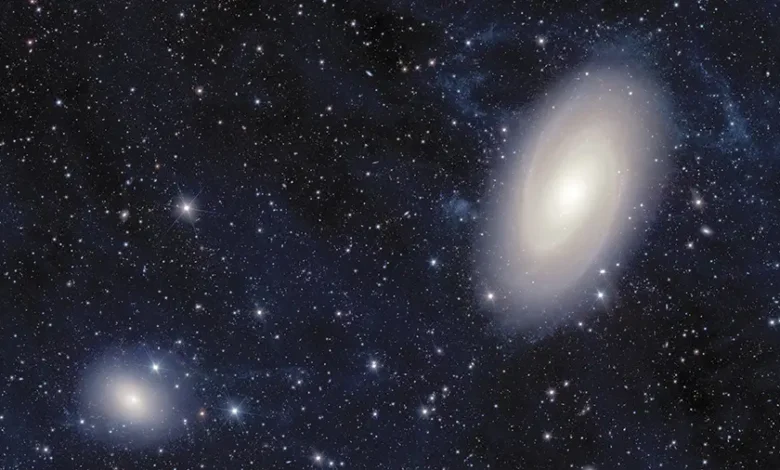
ESA’s Euclid space telescope has delivered its largest data set so far, a release of about 13 months of observations totaling 1.7 petabytes. It includes images of more than 900 million galaxies and spectra of more than 160 million sources. Within that material, astronomers have identified roughly 60 million possible quasars and around 15,000 strong gravitational lens candidates.
The release covers 1,900 square degrees of sky, equivalent to about 9,500 full Moons. It contains raw data, calibrated images, catalogs, spectra and large-area mosaics. One northern-sky mosaic combines 740 observations from autumn 2024 and spring 2025. It spans 367 square degrees, and its full-resolution version contains 500 gigapixels. ESA Director of Science Carole Mundell described the release as a scientific milestone rather than simply a collection of images.
A jump in scale from the preliminary release
Last year’s preliminary data release covered 63 square degrees, about 300 full Moons, gathered in a single week. The new release spans roughly 30 times that area and includes about 35 times as many galaxies.
The strong-lens catalog has grown by a similar factor, and ESA says it now exceeds all earlier strong-lens catalogs combined. Strong lensing occurs when the gravity of a foreground galaxy distorts the light of a more distant one into arcs or rings. The effect is rare, with only about one galaxy in several thousand acting as a lens.
Euclid project scientist Valeria Pettorino (ESA) said the survey’s area and image resolution make it possible to study such lenses as a population instead of as isolated cases. The candidates were found using machine learning, expert inspection and the work of thousands of citizen scientists who searched Euclid images through the Space Warps project on Zooniverse. Euclid Consortium member Natalie Lines (University of Portsmouth) noted that researchers forecast more than a decade ago that Euclid would transform strong-lens discovery.
Early-release data have already produced a body of research. A special issue of Astronomy & Astrophysics published in June 2026 contained 41 papers, including a catalog of 380,000 galaxies classified by shape, a resource for studying galaxy evolution. Eight papers based on the new data are on the arXiv preprint server, with more expected.
Cosmology results still to come
The release is an interim step toward the mission’s first full data release, DR1, scheduled for mid-2027. DR1 will add more raw data and higher-level products, including weak gravitational lensing measurements and calculations of how galaxies and clusters fit into the cosmic web. Pettorino said those products need more time for scientific validation, so Euclid’s first cosmology results are not expected before then.
The current release covers about 14% of the area Euclid will eventually survey. Over six years, the telescope will map roughly 14,000 square degrees, about a third of the sky, avoiding the dusty plane of the Milky Way. It will image around 1.5 billion distant galaxies spanning about 10 billion years of cosmic history, and it will revisit three Deep Fields to reach greater sensitivity.
Euclid launched in July 2023 and observes from the Sun–Earth L2 point, about 1.5 million kilometers from Earth on the side facing away from the Sun. Its main goal is a 3D map of the universe that sheds light on dark matter and dark energy. Dark matter reveals itself by bending the light of background galaxies, so measuring subtle distortions in millions of galaxy shapes should let scientists chart its distribution along the cosmic web. Dark energy, the unknown cause of the universe’s accelerating expansion, will be probed through spectroscopy, which gives galaxy distances. Comparing how galaxies are arranged at different epochs can show how dark energy has affected expansion.
Unplanned finds
The data are also supporting work beyond the survey’s core aims. A few weeks ago, Euclid discovered a new comet that happened to cross one of its Northern Deep Fields. In a separate, deliberate observation, the telescope turned away from its survey fields for 26 hours to look at more than 60 million stars in the Milky Way’s central bulge in a search for exoplanets. Pettorino said Euclid and its instruments are performing extremely well.
Source: skyandtelescope.org