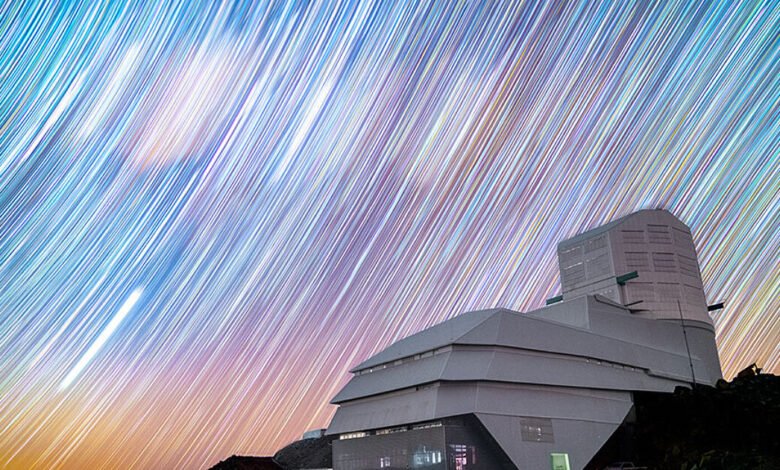
The Vera C. Rubin Observatory is built to watch the same patches of sky over and over. That repetition is what makes it useful for planetary defense: anything that shifts position between images stands out, whether it is an asteroid crossing the Solar System or a star that suddenly brightens or explodes.
When the telescope detects such a change, it sends an alert to a network of other telescopes so they can follow up on the object. Rubin is a joint project of the U.S. National Science Foundation (NSF) and the U.S. Department of Energy’s (DOE) Office of Science.
A steady view for finding moving objects
Many observatories adjust their pointing to hunt for specific targets in different parts of the sky. Rubin works differently, photographing one area repeatedly. This steady coverage improves its ability to pick out objects that move from one image to the next. As a result, Rubin is expected to find 5 to 10 times more Solar System objects, including comets and asteroids, than were known before.
Early results from the survey
The effect showed up soon after the survey began. When Rubin released its first images on June 23, 2025, the team announced 2,104 previously unknown asteroids, all found in roughly 10 hours of test observations. Among them were seven near-Earth objects, 11 Jupiter Trojans and nine objects beyond Neptune.
Broader science goals
Planetary defense is one part of a wider research program. Rubin’s primary science goals are:
- understanding the nature of dark matter and dark energy
- creating an inventory of the Solar System
- mapping the Milky Way
- exploring objects that change position or brightness over time
The last two goals draw on the same repeated imaging that allows Rubin to find asteroids and issue alerts about transient events.
Source: www.planetary.org