NASA’s attempt to lift the Neil Gehrels Swift Observatory into a safer orbit failed, and the gamma-ray telescope reentered Earth’s atmosphere on Nov. 4, 2026. It came down at 7:39 a.m. EST over Indonesia’s North Sumatra region, ending a mission of nearly 22 years. NASA expected most of the spacecraft to break up completely, though some components may have reached the surface.
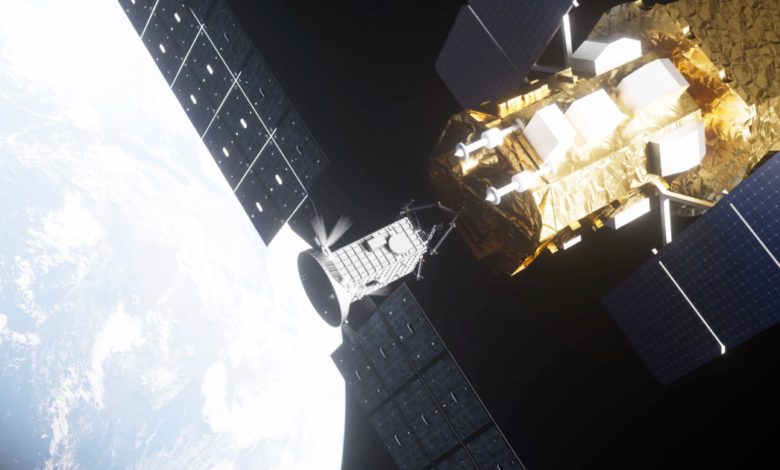
The outcome was effectively decided in August, when NASA announced that Katalyst Space’s LINK servicing spacecraft would still meet Swift but would make no attempt to raise its orbit. An attitude-control failure aboard LINK had ruled out the boost.
A rescue built in under a year
NASA hired Katalyst Space Technologies, a startup in Flagstaff, Arizona, in September 2025 to attempt the rescue. Heightened atmospheric drag from solar maximum was pulling Swift down faster than expected, and NASA projected it would reenter in 2026. Katalyst had less than a year to design and build LINK to rendezvous with the telescope, dock with it and push it to a higher altitude.
LINK launched July 3 on a Northrop Grumman Pegasus XL rocket. During the last weekend of July it lost control of two of its three reaction wheels. These spinning flywheels let a spacecraft point without using propellant, and three are the minimum needed to control all axes. LINK had no spares. Without them it tumbled at nearly 9 degrees per second, which disrupted communications with ground controllers.
Katalyst fired LINK’s electric thrusters for weeks to bring the spin down to about 1.47 degrees per second by early August. On Aug. 11 the company uploaded a flight-software fix that restored attitude control. By then Swift had sunk to 216 miles (347 kilometers), about 31 miles (50 km) above the altitude below which an orbit-raising effort would become much harder.
Rendezvous without a boost
LINK made its closest approach on Sept. 4, coming within roughly 8 miles (13 km) of Swift. NASA said that was as near as the spacecraft would get. Katalyst used the following days to test LINK, including raising its orbit, aligning it with Swift’s path and unfurling all three robotic arms. On Aug. 30 it fired all three xenon thrusters at once.
LINK deorbited and reentered on Sept. 25, after 85 days of operations. It did not capture or boost Swift, but NASA said the data collected would inform future missions. Neither NASA nor Katalyst had said beforehand whether LINK would dock with Swift or drift away.
Swift’s final months
Earlier in the year Swift’s team had powered down its ultraviolet/optical and X-ray telescopes to reduce drag and slow the decay. With the boost abandoned, the team switched them back on Aug. 26. The Burst Alert Telescope was expected to follow in the weeks after.
Swift made significant contributions to understanding gamma-ray bursts, the most energetic explosions in the universe. NASA plans to rely on its other missions to cover the gap in burst monitoring.
NASA Administrator Jared Isaacman said the result was not the one the agency wanted but did not change the reasons for trying. Shawn Domagal-Goldman, director of NASA’s Astrophysics Division, described the effort as a high-risk, first-of-its-kind attempt on a timeline set by solar activity. He said the agency had hoped for more science from Swift but had gained from the work done along the way. NASA also intends to apply what LINK’s rendezvous showed about robotic servicing to later missions.
Source: www.astronomy.com