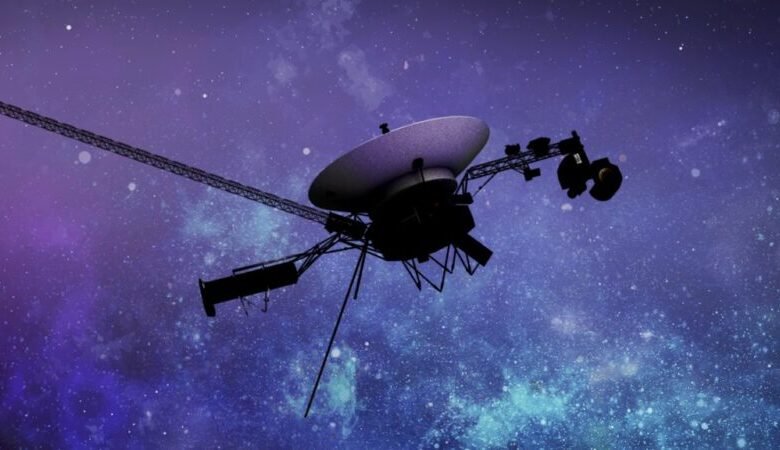
NASA says Voyager 1 will reach a distance of one light-day from Earth at 12:16:07 a.m. CST on November 18, 2026. No human-made object has traveled so far. One light-day is the distance light covers in 24 hours, roughly 16.1 billion miles (25.9 billion kilometers), or 173.14 astronomical units.
As of early October, the spacecraft was about 15.98 billion miles (25.72 billion km) from Earth. Light leaving it at that point took 23 hours, 52 minutes and 30 seconds to arrive, so a signal sent in mid-November will cross the 24-hour threshold. Voyager 1 launched on September 5, 1977, meaning it will have taken about 49 years to get there.
From Jupiter and Saturn to interstellar space
Voyager 1 flew past Jupiter and Saturn before heading out of the solar system. In 2012 it crossed the heliopause, the boundary of the Sun’s sphere of influence, and became the first spacecraft to do so. It is moving out of the plane of the planets toward the constellation Ophiuchus.
A worldwide “Shine Bright” event
To mark the milestone, NASA is organizing a global Shine Bright celebration. After sunset on Tuesday, November 17, participants are invited to aim a flashlight, phone, glow stick or other light at the sky and flash “V-G-R,” for Voyager, in Morse code.
The letters translate as follows:
- V: dot, dot, dot, dash
- G: dash, dash, dot
- R: dot, dash, dot
NASA also offers an automated flasher for those who prefer not to key the code by hand. The agency hopes the display will recognize the achievement of sending a spacecraft farther than any other human-made object.
Voyager 2 is farther behind
Voyager 2 launched a few weeks before its twin but took a different route. It visited all four giant planets, Jupiter, Saturn, Uranus and Neptune, and is therefore not as distant. It trails Voyager 1 by about 2 billion miles (3.2 billion km) and moves a bit more slowly, so it will not close the gap.
The two craft are also heading in different directions. Voyager 2 is traveling “down” out of the solar plane, toward the constellation Andromeda. NASA says it will reach one light-day from Earth in November 2035.
A shrinking set of instruments
Both spacecraft remain in contact with Earth, though a one-way message takes about a day. Most of their instruments, however, are no longer working. NASA has shut down systems one at a time over the years to conserve power. The most recent was the Low-Energy Charged Particle (LECP) instrument, switched off in April 2026. It had been detecting electrons, ions and cosmic rays in the interstellar medium. NASA could turn it back on later for new measurements.
Each Voyager also carries a golden record etched with images and sounds meant to represent life on Earth. The records are largely symbolic, a message cast out on the slim chance that another civilization finds them. Carl Sagan said they would be played only if advanced space-faring civilizations exist in interstellar space, but that sending them says something hopeful about life on Earth.
Source: earthsky.org