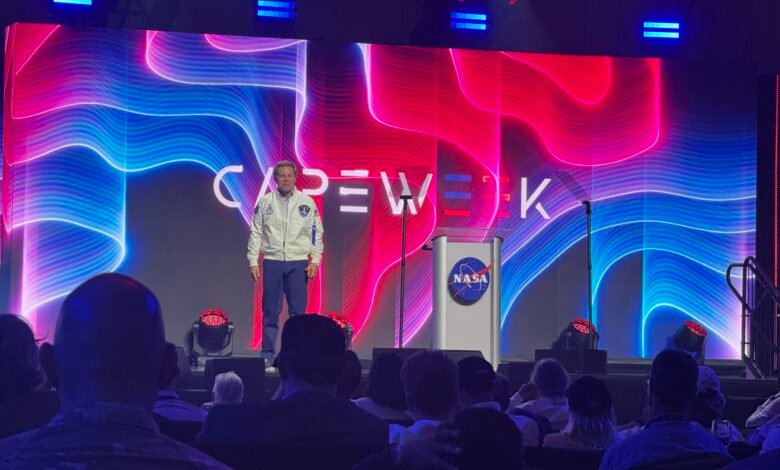
Rep. Mike Haridopolos (R-FL), who chairs the House space subcommittee, says NASA’s Artemis program and its funding can withstand a Democratic-controlled House. In an interview with Payload at the UP.Summit at Kennedy Space Center, held days after the midterm elections, he argued that bipartisan backing for the agency will outlast the change in power on Capitol Hill. Haridopolos kept his own seat.
A fallback if budget talks stall
Haridopolos pointed to the past two years as evidence of cross-party support. He said NASA faced a potential 40% cut when the president returned to office, but Congress avoided any reduction and restored the proposed cuts. He also noted that last July’s One Big Beautiful Bill Act added roughly $9.9 billion to NASA spending.
If lawmakers cannot agree on a new budget, he said, a continuing resolution would hold NASA at current levels, which he described as workable. He credited NASA Administrator Jared Isaacman with spending carefully, and said 2026 may prove the agency’s best year since 1969.
Haridopolos acknowledged one recurring point of friction. Democrats on the science committee tend to favor more spending on environmental programs, he said, while Republicans prefer to prioritize aerospace and space programs over scientific research.
Space Ready Act and the race with China
Haridopolos wants a space reauthorization bill that includes the Space Ready Act. It would fund investment in NASA facilities, in the way the Department of War invests in its own infrastructure, and would extend beyond Kennedy Space Center. He said it would also let private companies build launch pads and other infrastructure themselves instead of waiting on government timelines.
He framed the broader stakes as a race with China to reach the Moon’s south pole, where water may exist and sunlight could provide a steady energy source. Haridopolos said he fears that a Chinese arrival first could lead to territorial claims, despite the 1967 Outer Space Treaty.
Artemis schedule and landers
Haridopolos said he does not expect major changes to Artemis. Citing the success of Artemis I and II, he said Artemis III and IV are scheduled by 2028, and that the schedule cannot be easily rearranged.
He acknowledged that Democrats may be uncomfortable with SpaceX CEO Elon Musk’s politics, but said Artemis should not be judged on them. He hopes SpaceX, Blue Origin or both deliver their lunar landers. He said he visited Blue Origin two to three weeks ago and saw the next vehicle intended to land on the Moon without astronauts.
Launch capacity outlook
Asked about a possible launch crunch as SpaceX transitions to Starship, Haridopolos said he was not worried. He expects new entrants such as Stoke Space, Relativity and Blue Origin to absorb demand, citing commercial incentives to launch satellites and the proven performance of vehicles like Blue Origin’s New Glenn. He said he is confident the U.S. goal of 1,000 launches a year will be met.
The statements are Haridopolos’s own views and expectations. The new House’s actual stance on NASA appropriations and reauthorization will become clear only as budget negotiations begin.
Source: payloadspace.com