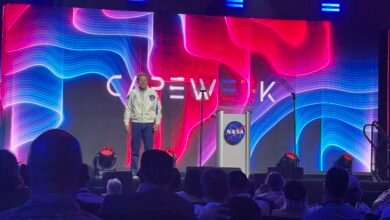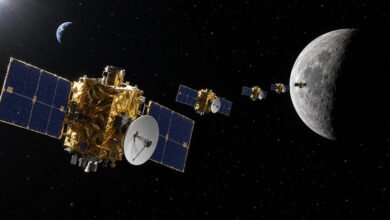
A former NASA Space Shuttle Flight Director is arguing that the commercial lunar sector needs to move past the single successful touchdown and design landers as recurring transportation systems. Robert Kelso, who directed 25 shuttle missions from Mission Control at Johnson Space Center and later managed commercial lunar lander development, set out the case in a commentary on engineering and operational lessons from recent Moon landings. His view is that a lander that completes one mission has not shown that its design and supporting infrastructure can handle repeated landings, departures and cargo deliveries in the same area.
Navigation that survives sensor loss
Kelso points to the descent from low lunar orbit to touchdown as a critical period for guidance, navigation and control. Landers typically combine inertial measurement units, altimeters, Doppler LIDAR, optical navigation, terrain relative navigation and hazard detection systems. He argues that the architecture should give overlapping coverage through the whole descent, so that losing one sensor does not end the landing. Single-fault tolerance for critical landing functions, he says, should be a core objective, and redundancy must account for common-mode failures.
Engine exhaust complicates the final tens of meters by kicking up dust and ejecta that can degrade optical and surface-referenced measurements. The vehicle may then depend on inertial propagation, which carries accumulating position and velocity uncertainty that the system must manage. Kelso says autonomy is essential but must come with fault management and a well-understood degraded mode, so it does not become a single point of failure.
Plume effects on surface infrastructure
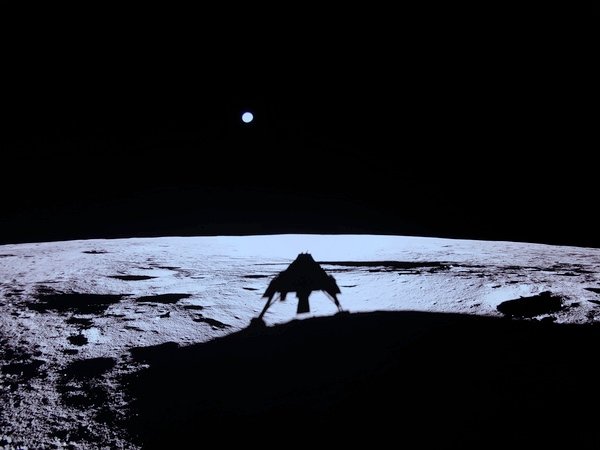
Kelso also highlights the hazard that exhaust-driven regolith poses to nearby hardware. He notes that analyses of plume-surface interactions have considered particle velocities approaching 2,000 meters per second. The particles can travel in a dense sheet roughly one to three degrees above the horizontal surface, and the sheet can continue past the lunar horizon. Solar arrays, habitats, antennas, rovers and instruments within line of sight could be damaged.
He cites Apollo 12’s landing near Surveyor III as an early example of exhaust affecting deployed equipment. A future Moon base with several landers, ascent vehicles and surface assets would need designated landing and ascent zones and separation from critical infrastructure. In his view, this is a lunar infrastructure planning problem as much as a lander design one.
Testing, margins and operability
Kelso cautions against trimming essential testing to save money or time. Lunar conditions cannot be fully reproduced on Earth, he notes, but integrated vehicle, software, interface and mission-sequence testing can be done thoroughly. He cites the loss of NASA’s Mars Polar Lander in December 1999. The investigation found a probable sequence in which transient signals from landing-leg deployment were read by software as touchdown, shutting down the descent engines about 40 meters above the surface. It also found that the full leg-deployment test was not repeated after wiring corrections and that immunity to such signals had not been adequately verified.
On program management, he urges protecting margins in cost, schedule and technical performance, including mass, power, propulsion and delta-V. He says the acceptable loss-of-mission probability should be set early by ownership and senior leadership as a management decision. For crewed vehicles, he adds, loss of mission and loss of crew are separate measures, and crew safety should drive additional requirements.
He also stresses operability, one of five Apollo-era design qualities alongside designability, flexibility, testability and evaluatability. He says operational requirements should be represented from mission concept review through preliminary design review rather than left to operations teams late in development.
Over the next five to ten years, Kelso says, the priorities include reliable autonomous precision landing, characterized landing zones, protection from plume effects, and common operational interfaces and traffic coordination among government and commercial providers. He does not call for identical vehicles, but says their operations must be compatible. That will require coordination among NASA, commercial providers and the organizations building lunar surface infrastructure.
Source: www.thespacereview.com