Researchers at Fox Chase Cancer Center have identified a protein that pancreatic cancer cells exploit to obtain cholesterol, and that also helps dampen the immune response against the tumor. The protein, anoctamin 6 (ANO6), could become a treatment target. The work, published in Nature Cancer, is preclinical and rests on laboratory and mouse experiments.
How tumors feed in a nutrient-poor environment
The study focused on pancreatic ductal adenocarcinoma (PDAC), the most common form of pancreatic cancer. PDAC tumors contain large numbers of cancer-associated fibroblasts (CAFs), which produce and organize connective tissue. As CAFs and their collagen fibers expand, they can compress nearby blood vessels and limit the tumor’s blood supply. Cancer cells keep growing under these conditions, and how they do so has been an open question.
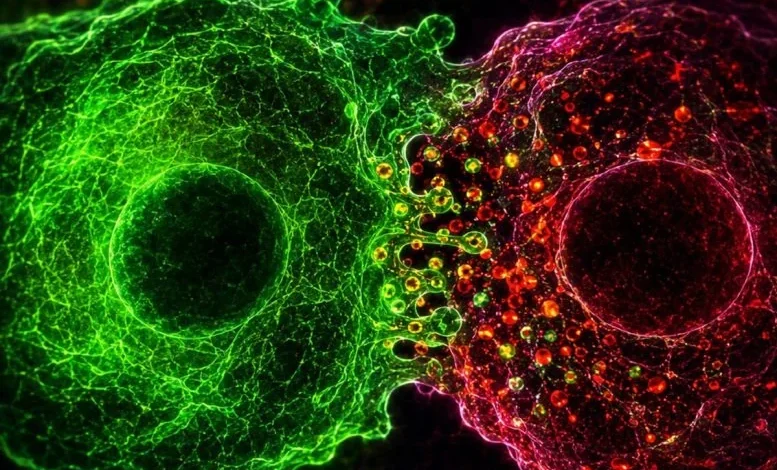
The Fox Chase team found that CAFs are part of the answer. According to Edna Cukierman, co-senior author and co-leader of the center’s Cancer Signaling and Microenvironment Program, CAF units take up cholesterol from the bloodstream and pass it to neighboring cancer cells through trogocytosis. In this process, one cell pulls small fragments of another cell’s membrane during direct contact. The cancer cells acquire CAF membrane pieces carrying cholesterol and other lipids that support survival and growth.
The transfer depends on ANO6, which helps prepare the CAF membrane for the exchange. When the researchers reduced or eliminated ANO6 in CAFs, the fibroblasts were less able to support cancer cell survival. In mice, tumors supported by CAFs with working ANO6 grew substantially faster than those supported by CAFs without it.
A second effect on T cells
The same mechanism appears to affect the immune system. Cytotoxic T lymphocytes, which recognize and kill cancer cells, can also pick up cholesterol-laden membrane material when they contact CAFs. Excess cholesterol in the tumor environment can contribute to T-cell exhaustion, leaving these cells less effective.
In mouse models, blocking ANO6 reduced cholesterol accumulation in tumor-infiltrating T cells and improved markers of their activity. In laboratory tests, T cells exposed to CAFs with reduced ANO6 killed cancer cells more effectively. Igor Astsaturov, the other co-senior author, said the team was surprised that one cellular mechanism both supplies lipids to cancer cells and weakens T cells. He added that targeting ANO6 could in principle disrupt both functions at once.
Drug tests in mice
The team also tested drugs that interfere with ANO6-dependent activity. In mouse models, niclosamide and clofazimine each significantly reduced tumor weight, and niclosamide also lowered cholesterol delivery to pancreatic cancer cells.
The authors stress several limits. All results are preclinical, and further research is needed to determine whether selectively blocking ANO6 would work in patients. Trogocytosis is also only one of several routes by which pancreatic cancer cells may obtain lipids. The researchers suggest the tested drugs might help against other difficult cancers, but that possibility has not been investigated.
Cukierman said that reducing ANO6 also disrupted a “stromal synapse-mimicry circuit” her group had identified earlier, which coordinates tumor nutritional support, CAF-unit metabolism and immune suppression. She described ANO6 as a mechanistic link tying together nearly a decade of the team’s work on how tissue surrounding pancreatic tumors supports cancer growth.
Charline Ogier and colleagues are the paper’s authors, with Cukierman and Astsaturov as co-senior authors and Serge Fuchs of the University of Pennsylvania among the co-authors. Funders include the National Institutes of Health, the American Cancer Society, the Pew Charitable Fund and the M&C Pancreatic Cancer Institute at Fox Chase, along with other foundations and private donors.
Source: scitechdaily.com