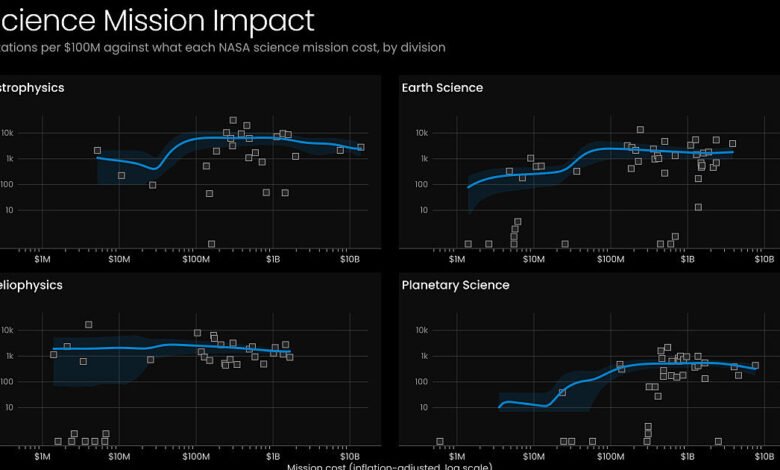
A new analysis of NASA science missions finds that mid-cost projects have delivered the strongest scientific return for the money, while the cheapest missions have been the most likely to fail. The study compared missions by scientific impact per dollar across the agency’s science divisions. Its findings bear on a long-running debate over whether many small missions or fewer large ones serve science better.
Where mid-cost missions stand out
In three of the four science divisions with enough missions to compare, missions costing between $150 million and $1 billion matched or beat both cheaper and more expensive missions in science per dollar. This cost band includes NASA’s Discovery, Explorer and New Frontiers classes.
The study also found that the most scientifically productive mid-cost missions have tended to be led by independent scientists who proposed them in open NASA competitions, rather than missions directed from within the agency.
Small missions fail more often
Among missions costing less than $150 million in the study, 30% failed. Among all more expensive missions, the failure rate was 8%. According to the analysis, the small-mission class as a whole would match larger missions in efficiency only if each surviving small mission were about a third more productive on average. The data show that they are not.
Nor did lower cost translate into faster results. Flagship missions take a long time to build, but many very low-cost missions produce no high-impact science at all. Those that do can take as long to get there as mid-cost missions.
Commercial lunar landers lag in publications
The study also looked at NASA’s Commercial Lunar Payload Services (CLPS) program. The four CLPS missions flown so far have each produced fewer scientific papers than comparable NASA-led science missions, measured from the start of operations.
Limits of the findings
The authors say the results do not argue for abandoning either small or large missions. Their conclusion is narrower: if the goal is high-impact science more quickly, top-down small missions have historically not delivered it.
They note that small missions have other benefits. They train people who go on to lead in the space industry, they test new technology, and some return excellent science. Flagships, in turn, make discoveries once considered out of reach and sustain scientific communities for decades. The authors describe the full range of mission sizes as interdependent.
Source: www.planetary.org