Astronomers at Northwestern University have developed a computational method that pulls faint exoplanets out of the glare of their host stars in James Webb Space Telescope (JWST) coronagraph data. The technique, called FLIP, recovered a planet that earlier analysis of the same data had missed. It also improved sensitivity by as much as 15 times over the current standard approach. The work appears in Nature.
Why starlight is the central problem
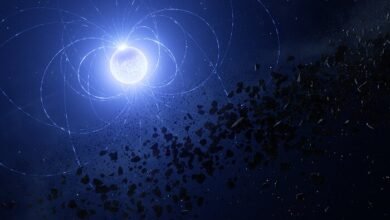
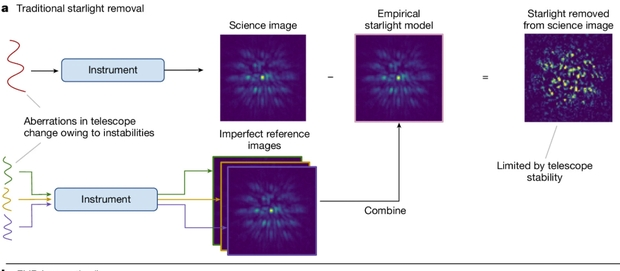
Planets are roughly a million times fainter than their stars, according to lead author Rodrigo Ferrer-Chavez. A coronagraph blocks most of the starlight, but some leaks into the image. Astronomers must then remove the remainder through processing, often with the help of reference stars.
That leftover glare is the star’s point spread function (PSF). Its shape depends on the star and on quirks of the instrument, including pointing errors, star–coronagraph misalignment and thermal drift. Even changes of a few nanometers in the telescope can alter the pattern. Jason Wang, who leads the Northwestern research group, notes that thermal changes can make a mirror expand or contract by a picometer, even though JWST has cryocoolers to hold its temperature steady. The cryocoolers themselves can introduce vibrations that affect images.
How FLIP works
FLIP stands for Physics-based Learning for Imaging Planets. The widely used method it is measured against is KLIP, or Karhunen–Loève image processing, which builds an empirical PSF model from reference images. When the telescope’s aberrations shift between observations, those references no longer match the science image, and the subtraction is imperfect.
FLIP instead builds a digital twin of the telescope. The model is calibrated on reference images to reproduce the reference PSF. It then solves for small changes in the telescope’s aberrations that better explain the science image. With the starlight that the coronagraph fails to block modeled more accurately, the background glare can be subtracted more precisely.
Results from JWST data
The team’s primary targets were HIP 65426 and 51 Eridani. In JWST data several years old, FLIP detected 51 Eridani b. Ground-based telescopes had found the planet before, but carbon dioxide in its atmosphere absorbs light at the infrared wavelengths JWST uses for these observations. That left the planet indistinguishable in images from the Near-InfraRed Camera (NIRCam). Wang described the detection as science that had been left on the table for lack of suitable analysis tools.
The researchers also applied FLIP to JWST data on TYC 5899, a star with no known planets, and found sensitivity 15 times better than KLIP. The paper describes the method as able to identify sources up to 100,000 times fainter than the host star.
The authors say the tool should allow JWST’s existing instruments to detect fainter, colder or less massive planets. They focus on giant planets at wide separations from their stars, a difficult regime for any detection method, and they expect the approach could be extended to JWST’s Mid-Infrared Instrument (MIRI).
Limits and implications for Habitable Worlds Observatory
The paper acknowledges that the models are not yet systematically calibrated to retrieve accurate estimates of instabilities and their uncertainties. The authors list several areas for improvement:
- a more sophisticated detector model for deep observations of very bright stars;
- disentangling degeneracies between model parameters;
- exploring algorithm hyperparameters to reduce computational cost;
- a framework for handling the large data volumes of ground-based applications.
The findings bear on NASA’s planned Habitable Worlds Observatory (HWO), which aims to image Earth analogues around Sun-like stars, a brightness contrast of 1010. The paper notes that this goal demands stability at the picometer level, 100 to 1,000 times better than JWST achieves. The authors suggest that methods like FLIP, which depend less on observatory stability, could partially lift that requirement. That would open up design options, although the source does not say how or whether HWO’s design or budget would change.
The study is Ferrer-Chavez et al., “Imaging exoplanets below the telescope stability limit,” Nature 659 (2026), 58–62.
Source: www.centauri-dreams.org