Mars and Jupiter reach conjunction in the predawn sky of Monday, November 16, 2026, the centerpiece of a mid-November stretch that also brings a weak Leonid meteor shower, a first-quarter Moon passing Saturn, and a well-placed Mercury and Venus at dawn. Descriptions below apply to mid-northern latitudes, and Moon positions are for North America.
Mars, Jupiter and Regulus Tighten Up
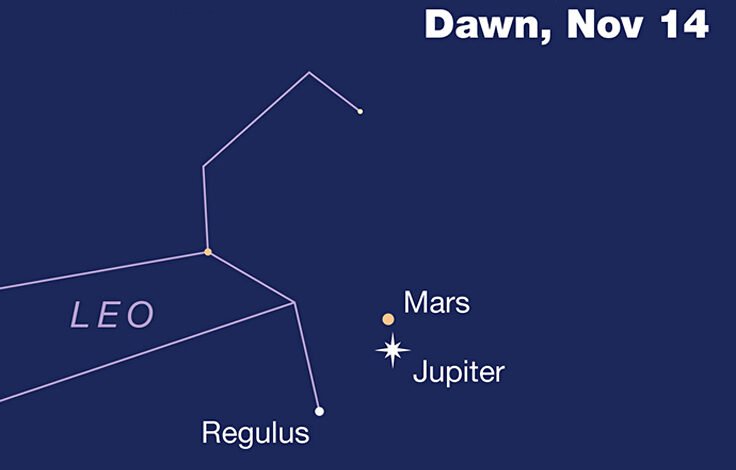
The two planets rise together in the east-northeast around 11 p.m. and stand high in the southeast by early dawn. Regulus, the magnitude +1.4 lead star of Leo, rises about 25 minutes after them. On November 14, the trio fits inside a 5.3° circle. By November 22 the circle shrinks to 3.6°, and the triangle changes shape from morning to morning as Mars moves east against the stars.
Jupiter shines at magnitude –2.1 and Mars at +0.7. In a telescope Jupiter spans 36 arcseconds, small for the planet, and Mars is only about 7 arcseconds wide, too small to show more than a hint of its north polar cap.
Leonids Peak Under Dark Skies, but Weakly
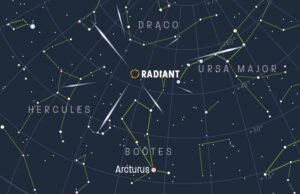
The Leonid meteor shower peaks late on the nights of November 16 and 17. The first-quarter Moon sets around 11 p.m. on the first night and near midnight on the second, so the hours before dawn are free of moonlight. The shower has been weak for about two decades, though, and even under excellent conditions observers should expect only around 10 meteors per hour.
The Moon reaches exact first quarter at 6:48 a.m. EST on November 17. That evening it sits due south as twilight ends, with Fomalhaut, Altair and Saturn arranged around it. By November 18 it lies near the middle of a broad “bowl” of bright points that includes Saturn, Beta Ceti, Fomalhaut and Delta Capricorni. Saturn, at magnitude +0.6 in Cetus, will eventually drift away from this pattern.
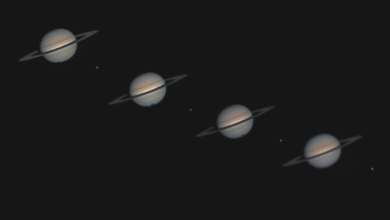
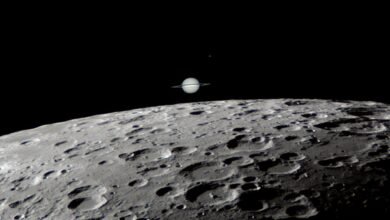
On November 19 the Moon and Saturn are about a fist apart, and on November 20 the gap is half that. Saturn is roughly 3,500 times farther away than the Moon and 35 times wider, not counting its rings. Amateur imager Christopher Go recorded ring-spoke activity on October 26, and the spokes had changed noticeably two nights later. Spokes appear during certain seasons of Saturn’s 29.5-year orbit, and this is one of them.
Mercury and Venus at Dawn
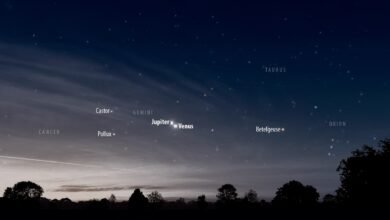
Low in the east-southeast, Venus shines at magnitude –4.6 with Mercury to its lower left. Mercury brightens from magnitude +0.2 on November 14 to –0.5 on November 21, when it reaches its highest point for this apparition at mid-northern latitudes. Its 7-arcsecond disk appears about half lit in a telescope. Venus is a 48-arcsecond crescent, and Spica, magnitude +1.0, stays within 2° of it all week. The three objects slowly separate over the period.
Sky & Telescope’s Bob King is collecting reports from observers who try to see Venus’s crescent without optical aid, a feat that probably requires vision of 20/15 or better. Looking through a small pinhole in thick paper may help. The source cites Edgar Allan Poe’s 1847 poem “Ulalume” as a likely naked-eye Venus sighting. A crescent Venus and crescent Moon did appear together low in the east below Leo before dawn on November 4, 1847.
Outer Planets for Telescope Users
Uranus, at magnitude 5.6 in Taurus, lies between the Pleiades and Aldebaran and can be found in binoculars with a good finder chart. Its two brightest moons, Titania and Oberon, at about magnitude 13.5 and 13.7, are possible targets for 10- to 12-inch telescopes. Neptune, at magnitude 7.8 near the Circlet of Pisces, lies 7° west of Saturn. Its moon Triton, at magnitude 13.6, is within reach of similar apertures.
Source: skyandtelescope.org