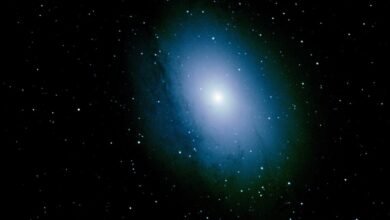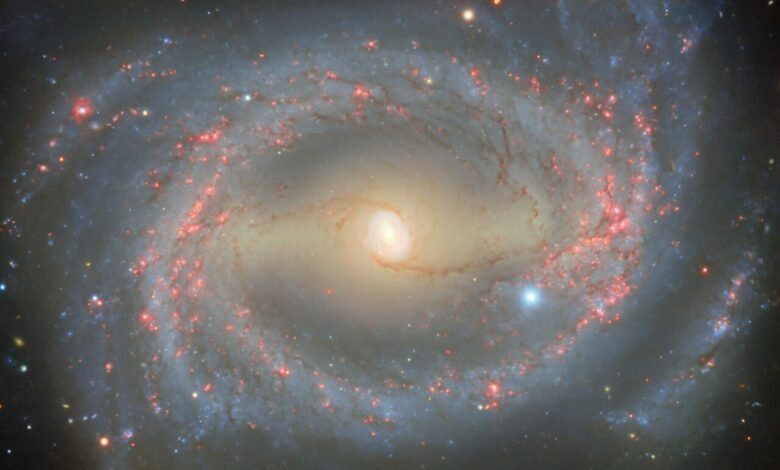
A young Type Ia supernova is brightening in NGC 1433, a barred spiral galaxy in the southern constellation Horologium, and NSF NOIRLab is coordinating observations to follow it. The explosion, designated SN 2026ahvu, was caught well before its expected peak. That gives astronomers a chance to study the early phases of a thermonuclear stellar explosion in a relatively nearby galaxy. New images from the Dark Energy Camera (DECam) and Gemini South show the event against its host galaxy.
Discovery and classification
The Asteroid Terrestrial-impact Last Alert System (ATLAS) recorded the object on 2 November 2026 at about 04:20 UTC (MJD 61346.181) through a cyan filter. It was first logged as AT 2026ahvu. On 3 November, spectroscopy with the DEIMOS instrument on the Keck II telescope classified it as a young Type Ia supernova, and it received its SN designation.
At discovery the supernova had an apparent magnitude of roughly 17. Within days, observations reported it at magnitude 13.5. On the astronomical scale, smaller numbers mean brighter objects. NGC 1433 lies approximately 50 million light-years away, though NOIRLab notes that published distance estimates vary. The supernova sits to the right of and slightly below the galaxy’s center.
What astronomers expect next
The supernova is predicted to peak between magnitude 10.5 and 12.1, between 18 and 23 November. Those figures are estimates and may be refined as data accumulate, and the peak can occur at different times in different filters.
NOIRLab describes SN 2026ahvu as one of the nearest Type Ia supernovae observed since SN 2011fe appeared in the Pinwheel Galaxy (Messier 101) in 2011.
Type Ia supernovae result from the thermonuclear destruction of white dwarfs, the dense remnants of Sun-like stars. In the scenario described in the release, the white dwarf has accreted matter from a close companion. Astronomers use these explosions as standard candles for measuring cosmic distances, because their intrinsic brightness is well known. Open questions remain about which stellar systems produce them and exactly how they ignite. Early observations can help distinguish between explosion scenarios and reveal signs of interaction with a companion star or surrounding material. Measuring the supernova’s peak apparent brightness will also sharpen the distance to NGC 1433.
A multi-facility campaign
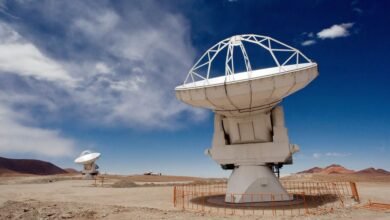
DECam is mounted on the Víctor M. Blanco 4-meter Telescope at Cerro Tololo Inter-American Observatory in Chile. It also imaged NGC 1433 before the explosion, during the Dark Energy Survey, which was led by Fermilab and ran from 2013 to 2019. Those archival images let astronomers compare the supernova’s surroundings before and after the event. The Gemini South images are sharper and show the system in more detail.
NOIRLab is arranging follow-up with Blanco/DECam, Gemini and the SOAR Telescope on Cerro Pachón. Repeated imaging will track changes in brightness and color, while spectroscopy will show the composition and speed of the expanding material. The aim is to follow the supernova from its first days through peak and into its long decline. The Gemini data come from Director’s Discretionary Program GS-2026B-DD-104 and are public through the Gemini Observatory Archive.
NOIRLab has also invited other ground-based and space-based observatories to contribute observations, which would extend coverage across wavelengths and time zones.
Within reach of amateurs
At its reported brightness, the supernova can be seen in small to moderately sized amateur telescopes under favorable conditions. Imaging can reveal it with smaller instruments than visual observation requires. It appears as a faint point of light. Its position is right ascension 03h 41m 55.511s, declination −47° 13′ 39.39″ (J2000). That southern location makes it difficult or impossible to observe from far northern latitudes.
Source: noirlab.edu