November 2026 brings a close pairing of Jupiter and Mars, a Leonid meteor shower with little moonlight to spoil it, and the first of three consecutive supermoons. Most of the action takes place in the morning sky, according to EarthSky’s skywatching guide for the month. Its charts are set for mid-northern latitudes, so times and positions will shift elsewhere.
Jupiter and Mars draw together
Bright Jupiter and red Mars shine in the east before sunrise and close in on each other through early November. They are closest at 3 UTC on November 15, when Mars passes 1.2 degrees north of Jupiter, a separation of a little more than two full-moon widths. The star Regulus, brightest in Leo, lies below them. The pairing is easy to see on the mornings of November 15 to 17. By late month, Mars moves away from Jupiter and sinks toward Regulus.
Leonids peak under dark skies
The Leonid meteor shower is best watched after midnight on November 17 through dawn on November 18. The radiant, the point in Leo from which the meteors appear to stream, rises around midnight and stands highest at dawn. The first quarter moon, which occurs at 11:48 UTC on November 17, sets around the time the radiant rises, so moonlight should not interfere. Jupiter and Mars will sit near the radiant.
EarthSky’s video preview recalls the Leonid storms of 1833 and 1966 and asks whether 2026 could bring another. The guide does not forecast one.
Earlier in the month, the South and North Taurids are active from late October through mid-November. Where their activity overlaps, observers may see 5 to 10 meteors an hour, and some may be fireballs brighter than Venus.
Moon highlights
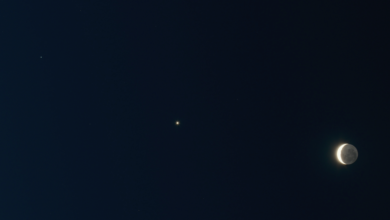
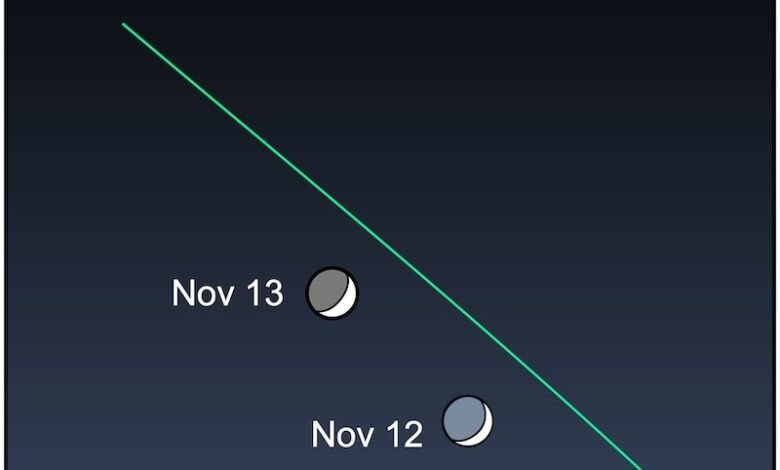
- November 12–13: A thin waxing crescent glowing with earthshine, low in the west after sunset.
- November 15–16: The moon, nearing first quarter, moves through Capricornus.
- November 19–20: The waxing gibbous moon lies near Saturn.
- November 23–24: The nearly full moon sits close to Aldebaran and the Pleiades on the 23rd. Full moon arrives at 14:57 UTC on November 24, the first of three supermoons in a row.
- November 25: The waning gibbous moon rises among Capella, Aldebaran and Betelgeuse.
- November 26–27: The moon passes near Castor and Pollux in Gemini.
- November 29–30: The moon, nearing third quarter, appears near Jupiter, Mars and Regulus, forming a tight group on the 30th.
Mercury, Venus and Saturn
Mercury reaches greatest western elongation, its widest angle from the sun in the morning sky, at 0 UTC on November 21. From the Northern Hemisphere it appears low in the east before sunrise, roughly midway between the horizon and brilliant Venus. Its steep path relative to the horizon lets it climb quickly through the twilight, which makes it comparatively easy to find. It begins descending by month’s end and fades from view by mid-December.
Venus sits beside the star Spica after November 5 and then moves away from it. It reaches its greatest brilliancy as a morning object on November 29.
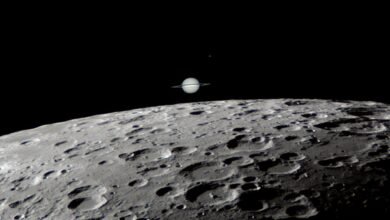
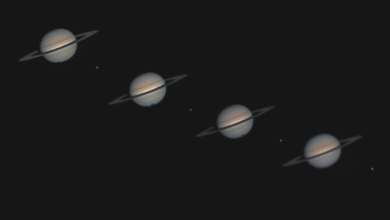
In the evening sky, golden Saturn shines in the east after dark and stays visible until after midnight all month. It remains well placed following its recent opposition, when it was biggest and brightest. By the middle of the night in late November, Jupiter and Mars are rising in the east while Saturn sets in the west.
Autumn stars
On November evenings, Cassiopeia and Cepheus ride high in the north, with Perseus following Cassiopeia up the northeastern sky. Perseus holds the variable star Algol and the Double Cluster, which Cassiopeia’s M or W shape can help observers locate.
Source: earthsky.org