


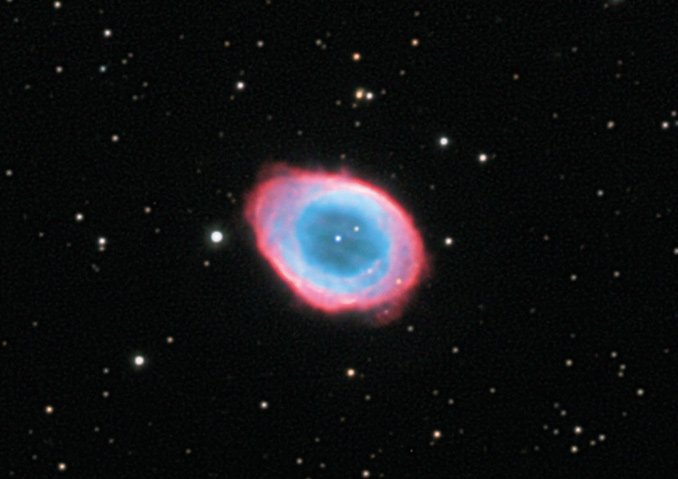
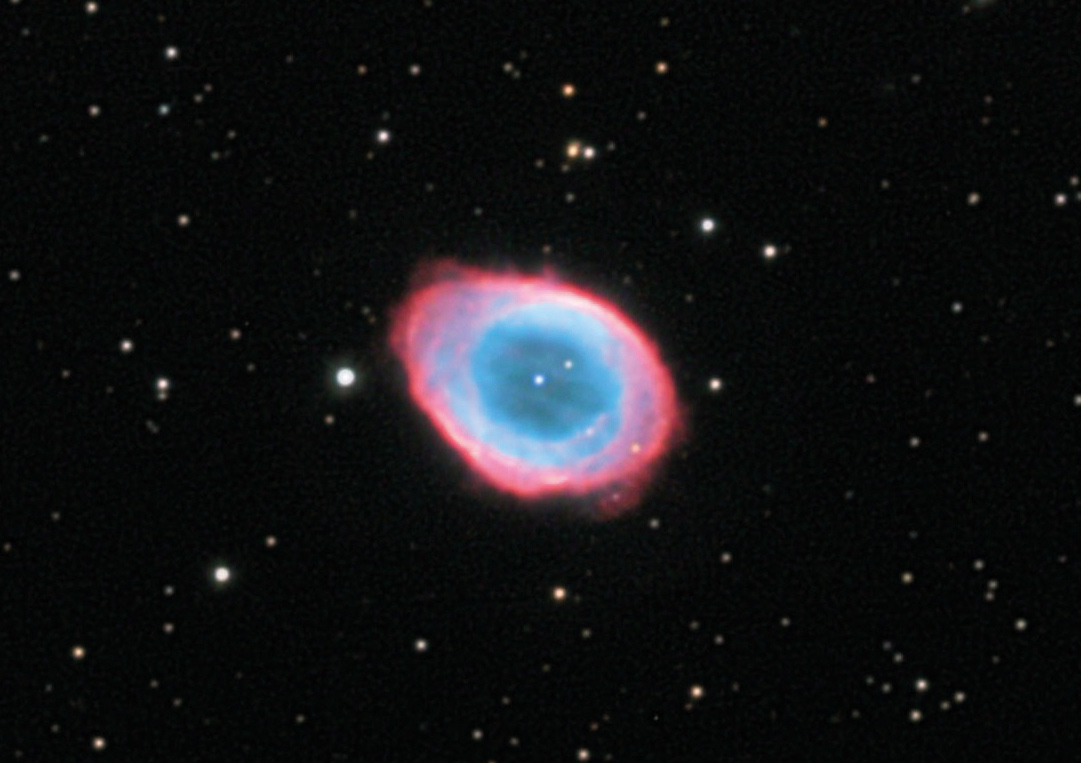
Messier 57, more famously known as the Ring Nebula, graces the constellation Lyra as one of the finest planetary nebulae in the night sky. A true summer showpiece, it’s remarkably easy to locate and observe—even through modest instruments as small as 80mm (about three inches) in aperture. As June nights fall, M57 rises swiftly in the east, already standing 50 degrees above the horizon by the time twilight yields to what little darkness midsummer offers. By mid-month, it culminates overhead, shining steadily through the warm season’s haze.
Though its appearance is striking, the Ring Nebula’s small apparent size—just 86 by 62 arcseconds—can be a slight letdown for those using binoculars. Its compact shape blends in with the surrounding stars, making it hard to distinguish at a glance. Still, it’s just bright enough, at magnitude +8.8, to be spotted with a pair of 10×50 binoculars. What it lacks in size, however, it makes up for with impressive surface brightness, especially across its elliptical central torus—an asset that helps it punch through the twilight-filled nights of early summer.
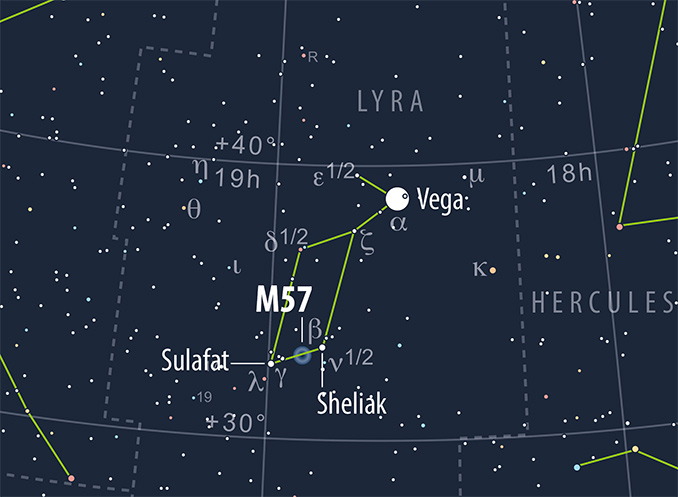
To find M57, start at Vega, the brilliant alpha star of Lyra, shining at magnitude +0.03. From there, sweep southeast about 6.7 degrees until you land between the third-magnitude stars Sheliak (Beta Lyrae) and Sulafat (Gamma Lyrae). Even at low magnification, a small telescope will reveal a surprisingly bright and delicate “smoke ring,” an ethereal sight that becomes even more dramatic as aperture and magnification increase.
A useful trick for enhancing the nebula’s visibility is to employ averted vision—don’t look directly at the Ring, but slightly to the side. This technique, which leverages the sensitivity of your peripheral vision, often causes the nebula to leap out more clearly against the sky. With a telescope in the 100–150mm (four- to six-inch) range, some internal brightness variations within the ring may begin to show. Using a narrowband O-III or UHC filter can significantly improve contrast, especially on nights when the atmosphere is calm and transparent.
At the heart of M57 lies one of the most celebrated white dwarf stars known among planetary nebulae. Spotting this faint stellar remnant is a challenge best attempted with a large telescope—something in the 400–500mm (16- to 20-inch) class—and under a dark, moonless sky, ideally in late August when the nights begin to stretch once more.
Recent amateur astrophotography has revealed astonishing details in the Ring Nebula, far beyond what early observers could capture. These images show that the Ring is surrounded by delicate, multi-layered structures that more than double its visual extent, transforming the simple ring into a complex and dynamic remnant of stellar evolution.
Discovered in 1779 by Antoine de Darquier de Pellepoix and observed soon after by Charles Messier himself, the Ring Nebula lies about 2,500 light-years from Earth. Its glowing gas envelope spans a radius of roughly 1.3 light-years—a beautiful, cosmic smoke ring marking the final stages of a star’s life.