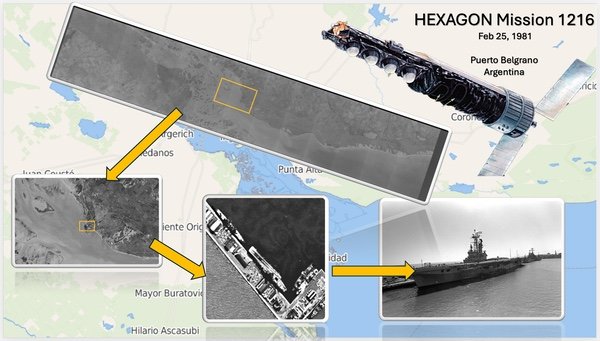
Newly declassified images from the American HEXAGON reconnaissance satellite program show that US intelligence tracked Argentina’s navy for years before the 1982 Falklands/Malvinas War. They include views of the aircraft carrier ARA Veinticinco de Mayo and the cruiser ARA General Belgrano at their home port. The pictures, published with an analysis in The Space Review by Dwayne Day, Harry Stranger and Mariano Sciaroni, span 1972 to 1984. They cover the ship’s service from its early years through the war and into its decline.
The surveillance was not aimed at Argentina alone. According to the authors, the United States watched navies worldwide, including that of Argentina’s regional rival, Brazil.
Two similar fleets, one key difference
A HEXAGON satellite photographed Puerto Belgrano, Argentina’s main naval base, in November 1972. The images show the carrier, two cruisers and other warships in port. At that time Argentina fielded the carrier, three light cruisers (soon cut to two), eight destroyers, three frigates and two corvettes. Brazil had a nearly identical carrier, two former US Navy light cruisers from World War II, eleven destroyers, five frigates and ten corvettes.
The carriers were close to sister ships. Veinticinco de Mayo served first as HMS Venerable and then as the Dutch HNLMS Karel Doorman before transfer to Argentina in 1968 and service entry in 1971. Brazil’s Minas Gerais had been modernized at a Dutch yard in the late 1950s. The main difference was in their aircraft. Argentina’s ship moved to A-4Q Skyhawk attack jets and S-2E Tracker anti-submarine aircraft in the 1970s, giving it a strike capability. Brazil’s carrier carried only Trackers, flown by the Brazilian Air Force, and could only perform anti-submarine work.
A second HEXAGON pass in February 1981 caught the carrier with General Belgrano astern. One of Argentina’s two cruisers had by then been retired.
The carrier in the 1982 war
During Operation Rosario on April 2, 1982, the carrier sailed with the covering force of Task Force 20. Her air group was Skyhawks, Trackers and Sea King helicopters. The newly acquired Super Étendards had not yet been integrated for carrier operations.
In early May, Rear Admiral Gualter Allara’s Task Group 79.1 operated north of the islands while the Belgrano group, TG 79.3, operated to the south. On May 1, Trackers located elements of the British fleet, and a Skyhawk strike was prepared for dawn on May 2. Near-calm winds and the carrier’s limited speed prevented enough airflow over the deck to launch the jets with a useful bomb load, so the strike was cancelled. Later that day HMS Conqueror sank the Belgrano.
The submarine threat then dominated Argentine naval planning. On May 5, two Trackers and two Sea Kings detected and attacked a submerged contact near the carrier, which was not a British submarine. With the fleet ordered into shallow coastal waters, the carrier entered port on May 10 and did not return to sea operations. Her Skyhawks continued to fly in combat from the naval air base at Río Grande. Declassified British archives indicate that British forces evaluated a long-range air strike on the ship in port, but the war ended before such planning advanced.
Final years
The last HEXAGON satellite to fly photographed the carrier at Puerto Belgrano in 1984, with two destroyers moored where the Belgrano had been. The ship had been modified to carry Super Étendards. By 1986 she was mostly confined to port, and modernization plans stalled for lack of funds. By 1996 she had been stripped of parts, some used to service Minas Gerais. She was towed to Alang, India, for scrapping in 2000.
The authors place her fate within a wider trend. Many of the light carriers Britain sold off in the 1940s and 1950s were worn out by the 1980s, and the number of carriers worldwide fell quickly as they were retired.
Source: www.thespacereview.com