The week of November 14–20, 2026, brings a Leonid meteor shower peak, a close pairing of Mars and Jupiter, and a run of planetary events in the predawn and evening sky. It ends with Mercury at greatest western elongation. Times below are Eastern unless noted, and observing details come from Astronomy magazine’s weekly sky guide by senior editor Alison Klesman.
Leonids peak under a setting Moon
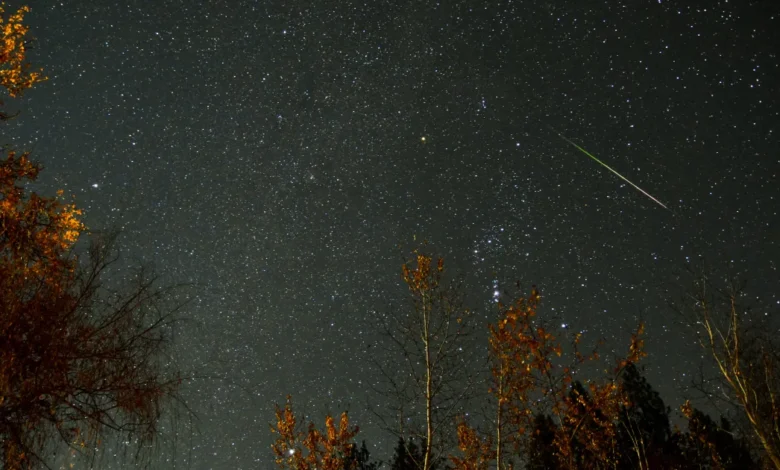
The Leonid meteor shower, produced by debris from Comet 55P/Tempel-Tuttle, peaks on November 17. The best viewing comes overnight into the early hours of November 18, after the waxing gibbous Moon sets around midnight and the radiant climbs higher. The radiant lies just inside the Sickle of Leo, near 3rd-magnitude Zeta Leonis, north of Mars and Jupiter.
Observers should look 40° to 60° to either side of Leo, where the longest meteor trains appear. The shower is not especially strong, and observers can expect about six or more meteors per hour. The Leonids are still among the fastest meteors of the year.
Mars and Jupiter, then Mercury and Venus
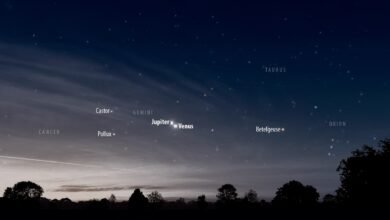
Mars passed 1.2° north of Jupiter at 10 P.M. on November 14. By 3 A.M. on November 15 the pair stood about 40° high in the east, west of Regulus, with Mars to Jupiter’s upper left. Both planets are heading toward opposition in February 2027. On the morning of November 15, Jupiter’s moons offered a busy sequence. Io’s shadow began crossing the planet at 3:22 A.M., Europa emerged from occultation at 4:27 A.M., and Io began its own transit at 4:36 A.M.
Closer to the horizon, Mercury has reappeared in the morning sky after inferior conjunction earlier this month. On November 14 it shone at magnitude 0.3, about 5° above the eastern horizon an hour before sunrise, less than 1° south of Kappa Virginis. Through a telescope it showed a 32%-lit disk 8″ across. Venus, at magnitude –4.8, sat 1.4° northwest of Spica and appeared 13% lit and 51″ across.
By November 19, Mercury was 55% lit and 7″ across, and had moved into Libra. Venus had shrunk to 47″ and was 18% lit. It passed 1.8° due north of Spica at 6 P.M. that day and is now heading east toward Libra. Mercury reaches greatest western elongation, 20° from the Sun, at 7 P.M. on November 20.
Saturn, Titan and Neptune
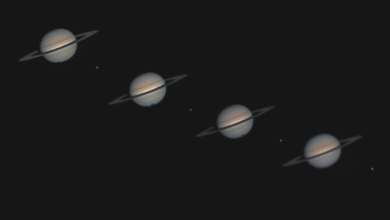
Saturn sits about 40° high in the southeast two hours after sunset. On November 16, Titan, at mid-8th magnitude, lay just south of the planet. Saturn’s rings span 43″ and are tilted 8° toward Earth, showing the southern side. The disk measures 19″. Rhea stood due north of Saturn around 10:40 P.M., and Tethys was due to be occulted at about 2:35 A.M. on November 16.
On November 20 the Moon passes 5° north of Neptune at 8 A.M. and 7° north of Saturn at 8 P.M. That evening the three form a triangle in the southeast, with the Moon upper left of Saturn and Neptune to its right. Titan then lies about 3.2′ west of Saturn, in line with the rings, though bright moonlight may hide the fainter moons.
Neptune, at magnitude 7.7 with a 2″-wide disk, requires optical aid. It lies 6.6° west-southwest of Saturn and about 2.6° southwest of 5th-magnitude 29 Piscium.
Moon and deep-sky targets
The First Quarter Moon falls at 6:48 A.M. on November 17, in Aquarius. The Moon reaches apogee at 12:50 P.M. on November 20, 252,040 miles (405,619 km) from Earth. Before moonset, the Pleiades (M45) offers an easy target. The cluster shines at a collective magnitude of 1.6, spans about 110′, and is roughly 30° high by 7:30 P.M. local time. Most observers see six or seven stars with the naked eye.
The Triangulum Galaxy (M33) is another option for dark sites after moonset. It lies 2.7 million light-years away and is the third-largest galaxy in the Local Group after Andromeda and the Milky Way. It shines at 6th magnitude but spreads across about 70′, so its surface brightness is low. Telescopes of 10 inches or more can reveal detail along its spiral arms, including knots of star formation.
Source: www.astronomy.com