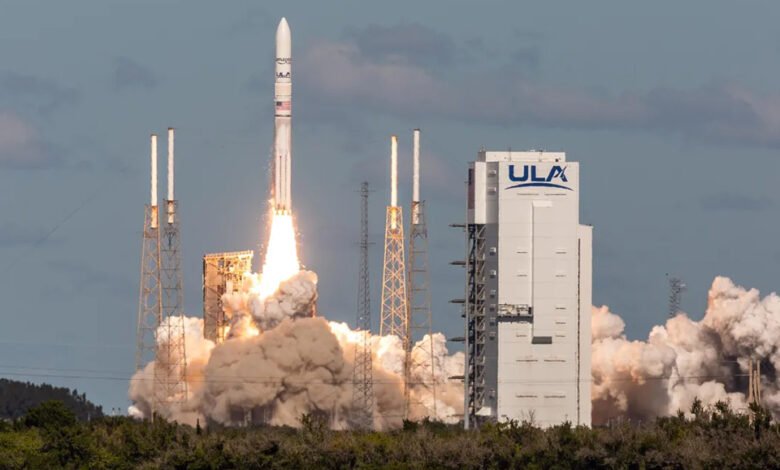
United Launch Alliance’s Vulcan Centaur rocket suffered an in-flight anomaly on Sunday, Nov. 15, and failed to reach orbit. The failure cost Amazon 40 broadband satellites for its Amazon Leo constellation. It came on the rocket’s first flight after a nine-month stand-down.
The mission, designated Vulcan Leo 1, lifted off from Space Launch Complex 41 at Cape Canaveral Space Force Station in Florida at 12:40 p.m. Eastern Time (1740 GMT). The vehicle did not reach low Earth orbit.
ULA confirms failure, cause unknown
About 50 minutes after liftoff, ULA confirmed the failure in a post on X. The company said its Launch Director had received data showing the anomaly occurred roughly 10 minutes into the flight, and that Vulcan did not deliver the Amazon payload to orbit. ULA added that because the event had only just happened, it had no specific data to explain the cause.
Return to flight after booster problems
Vulcan Centaur, the successor to ULA’s Atlas V, debuted in January 2024 and had flown four missions before this one. Two of them were affected by problems with a solid rocket booster (SRB). On the second flight, in October 2024, and again on the fourth, in February 2026, an SRB nozzle burned through and detached about 30 seconds after liftoff. In both cases the rocket still delivered its payloads.
After those incidents, the U.S. Space Force paused national security launches on Vulcan until corrective upgrades were made. ULA subsequently improved the nozzle design and related processes. The SRBs appeared to perform normally on Nov. 15, so the anomaly that stopped the rocket reaching orbit was a separate issue from the earlier booster problems.
Impact on Amazon Leo
Vulcan Leo 1 was the first Vulcan mission flown for Amazon Leo, the broadband network formerly known as Project Kuiper. The constellation is planned to include more than 3,200 satellites in low Earth orbit. Before this launch, roughly 400 spacecraft were in orbit, deployed over 15 launches on Atlas V, SpaceX’s Falcon 9 and Arianespace’s Ariane 6.
The loss of 40 satellites sets back deployment, though the source does not say how the failure will affect Amazon’s schedule or Vulcan’s flight plans. ULA’s investigation is only beginning, and the cause has not been identified.
Source: satnews.com