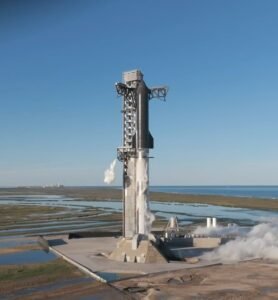
SpaceX caught the upper stage of its Starship vehicle at the Starbase launch tower in Texas on November 14, completing the 15th Starship Integrated Flight Test (IFT-15) after 14 orbits of Earth. It is the first time the company has attempted to catch the ship following an orbital mission. The tower’s arms, nicknamed Mechazilla or “chopsticks,” grabbed the vehicle on return. Jonathan McDowell’s timing puts the catch at 2120:02 UTC, or 4:20 pm EST.
A flight with one missed objective
IFT-15 lifted off from Starbase at 5:47 pm ET on November 13. SpaceX had hoped to recover both stages and claim the first fully reusable orbital mission, but the Super Heavy booster did not return to the tower. Its guidance, navigation and control system determined the booster was not in the correct position for a catch and automatically diverted it to a splashdown in the Gulf. SpaceX is still investigating the root cause.
The rest of the mission went as planned, including the deployment of 26 Starlink V3 satellites. These satellites are much larger than earlier versions and cannot fly on Falcon rockets, so Starship is the only vehicle that can launch them. SpaceX expects Starlink satellites and, eventually, Orbital Data Centers to be Starship’s main cargo.
Building on earlier tests
This was only the second orbital attempt for Starship. IFT-14, two months earlier, was largely successful but made no recovery attempt. That ship completed almost two orbits and splashed down in the north Pacific a little more than three hours after launch. SpaceX has previously caught three Super Heavy boosters at the tower minutes after liftoff, on IFT-5, IFT-7 and IFT-8.
The vehicles flown were Booster 22 and Starship 42 (S42). The number appears to be a nod to Douglas Adams’ The Hitchhiker’s Guide to the Galaxy, a favorite of SpaceX CEO Elon Musk. The book’s catchphrase, “Don’t Panic,” was painted on the side of the ship.
Why ship recovery matters
Starship is designed to be fully reusable with fast turnaround. Musk envisions thousands of launches per year from at least three sites: Starbase; Kennedy Space Center in Florida, where the first Starship could launch this year; and a newly announced site to be built in Vermilion Parish, Louisiana.
The closest historical comparison is NASA’s Space Shuttle. Over 30 years, the five orbiters returned from orbit 133 times and landed on a runway. The Solid Rocket Boosters were also reusable, but the Core Stage was not.
Lunar plans still depend on refueling
SpaceX holds a NASA contract to build a Human Landing System (HLS) version of Starship to return American astronauts to the Moon starting in 2028. That version needs in-orbit refueling to reach the Moon. Starship burns cryogenic propellants, and SpaceX has not yet demonstrated in-space cryogenic refueling. The capability would also be required for Musk’s goal of sending millions of people to Mars. IFT-15 is a step toward those goals, though many more are needed.
NASA’s Artemis III mission next year will test rendezvous and docking between the Orion capsule and a standard Starship, not the HLS variant. A docking adapter will be attached to the ship, but the crew will not be able to enter it. The Artemis III crew will also practice rendezvous and docking with Blue Origin’s HLS, Blue Moon MK2, which they will be able to enter.
NASA Administrator Jared Isaacman congratulated Musk and the SpaceX team on the result.
Source: spacepolicyonline.com