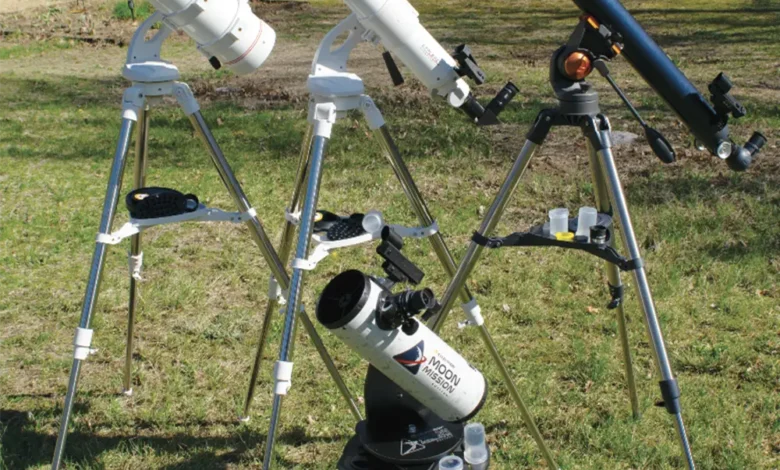
Sky & Telescope has reviewed four complete beginner telescopes that each sell for less than $200. Its reviewer found that the best of them now give new observers steadier mounts and sharper optics than the budget instruments that have long frustrated first-time buyers. The test, written by science teacher Joshua Roth, covered three tripod-mounted scopes and one tabletop Dobsonian from Celestron and Explore Scientific. Both companies loaned the review units and had no other role in the evaluation.
How the telescopes were tested
Roth and high-school senior Alden MacNulty observed Jupiter, the Moon, the Pleiades and the Orion Nebula under light-polluted winter skies in metropolitan Boston. Each telescope came with a mount and eyepieces and could be used after minor assembly. All four also use an industry-standard Vixen-style dovetail, so the optical tubes fit other mounts.
Celestron AstroMaster 70AZ
Roth named the 70-mm, f/12.8 refractor his top pick for ease of assembly and crowd-pleasing views. It weighs 5 kg (11 lbs). With its 20-mm and 10-mm eyepieces (45× and 90×), it showed Jupiter’s equatorial cloud bands and polar shading, plus all four Galilean moons. It also resolved the four brightest Trapezium stars in the Orion Nebula and showed no obvious false color. Its mount was the best of the group once the azimuth motion, which arrived too tight, was loosened with a hex wrench that is not supplied. Roth judged it the model most likely to last for years. Its StarPointer red-dot finder was the best he tested.
Explore Scientific FirstLight 80mm refractor
At $130, the 80-mm f/8 achromatic refractor produced what Roth called the best full-disk Moon views and took 64× magnification with an added 10-mm eyepiece. He saw little false color and minimal scatter. Its Twilight Nano mount is stable but slightly behind Celestron’s, and the tube clamp and other plastic parts looked like weak points. The included reflex sight is tinted so darkly that most bright stars could not be seen through it. Roth recommends swapping in Celestron’s $24.95 StarPointer, which fits the finder post and needs only a small screwdriver.
Explore Scientific FirstLight 114mm Newtonian
The 114-mm f/4.4 reflector has the largest aperture of the four and is the only one priced under $100. It showed the faintest stars and was the reviewers’ choice for star clusters, nebulae, galaxies and comets. Its short focal length produces coma at the edge of the field and six diffraction spikes on bright stars, and the refractors rendered stars more crisply. A supplied sub-aperture mask sharpens lunar and planetary views. It was the easiest of the three tripod models to slew and the only one comfortable for a standing adult. At 9 kg it is top-heavy, and it shares the problematic reflex sight.
Celestron Moon Mission 100mm Dobsonian
Despite its name, this 100-mm f/4 tabletop reflector ranked last for lunar viewing. At 20× and 50° it showed the whole lunar disk with maria, larger craters and some mountain ranges. Planetary views were poor at full aperture, and Roth could not resolve the Trapezium because the primary mirror’s tilt cannot be adjusted and the secondary needs a hex wrench that is not supplied. Its strengths are portability and weight of about 5 lbs. The tube can be handheld or mounted on a standard photo tripod, and it is the easiest of the four to fit into a car or closet.
Roth concluded that all four avoid the wobbly, hard-to-focus “hobby killer” designs that long dominated the budget market. Because they use standard hardware, they can grow with a beginner’s interest, with optional eyepieces and replacement finders.
Source: skyandtelescope.org