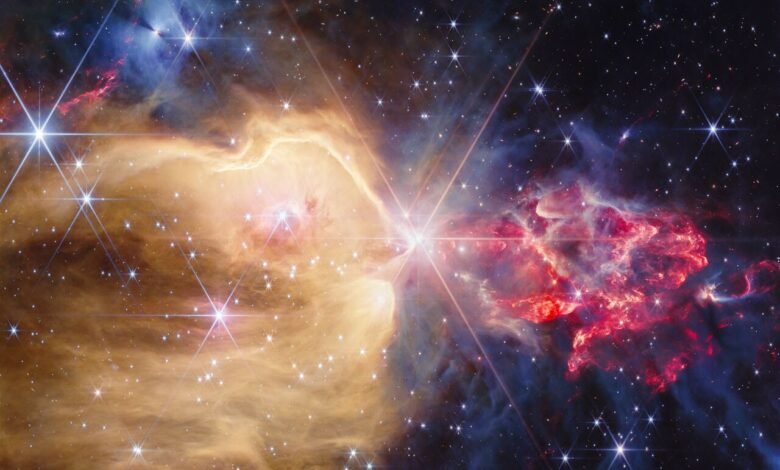
NASA has used the James Webb Space Telescope to capture a detailed infrared view of NGC 7129, a star-forming region where young stars at different stages of development appear side by side. The image offers astronomers a way to compare early phases of stellar growth and to judge which physical processes matter most, and when.
Stars form when gravity draws large quantities of gas together. The process rarely stays simple. Stars that have already formed release powerful jets and winds, and some eventually explode, all of which reshape the surrounding material and affect stars still taking shape.
Why infrared matters
Dust is a central reason astronomers turn to infrared observations. Opaque dust can form in the cool atmospheres of stars, and when it disperses it can block the view in visible-light images. Webb’s infrared imaging helps reveal regions that dust would otherwise obscure.
Two regions, different ages
The Webb image shows many stars in the process of forming. The young stars on the left side, embedded in gold-colored gas, are generally more mature than those on the right, which sit in a red-colored region. That contrast gives researchers a view of stellar development at more than one stage within the same field.
The red gas has a distinctly filamentary structure. Jets and winds from young stars are the likely cause of that texture, according to the image description, which presents this as a probable explanation rather than a settled conclusion.
What the comparison offers
Observing stars at various points in their development helps scientists refine their understanding of which processes dominate at each phase of star formation. In NGC 7129, the differing ages of the stellar populations and the visible effects of outflows are available in a single frame, which makes the region a useful reference for that kind of comparison.
Source: science.nasa.gov