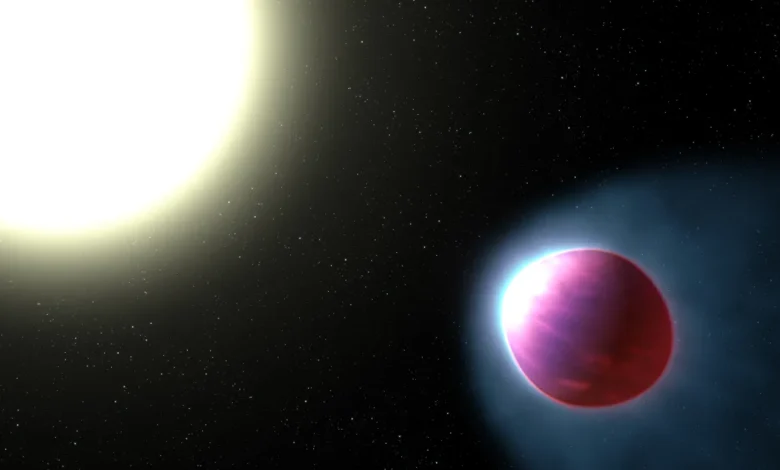
Planets are not perfect spheres, but most come close. Gravity pulls any body above a certain mass into a roughly round shape, and the departures from that shape depend mainly on how fast the planet spins and what it is made of. Some exoplanets in extreme orbits are exceptions, with one hot Jupiter, WASP-121 b, stretched into an elongated, football-like form by its star.
Why spin matters
Rotation sets up a contest between two effects. Material on a spinning planet tends to fly outward, while gravity draws it inward. The contest is most intense at the equator, so faster-spinning planets bulge more there. The result is an oblate spheroid, a sphere flattened at the poles.
The planets of our solar system show the range. Mercury and Venus are slow-spinning rocky worlds and are the most spherical. Earth and Mars rotate somewhat faster and are about 0.3% and 0.6% thicker at the equator than at the poles, respectively.
Solid surfaces add small irregularities. Satellite data show that Earth and Mars are slightly lumpy because their terrain is higher in some places than others. Earth’s Southern Hemisphere has marginally more surface area than its Northern Hemisphere, which makes the planet very slightly pear-shaped. The effect is tiny. On a basketball-sized model of Earth, the equatorial deviation from a perfect sphere would be about 0.03 inch (0.08 centimeter).
The gas giants bulge the most. Jupiter is nearly 7% thicker at the equator than at the poles, and Saturn is 10.7% thicker. The ice giants Uranus and Neptune are less distorted, at 2.3% and 1.7%, respectively.
Distorted worlds around other stars
Some exoplanets face harsher conditions. Hot Jupiters are large gaseous planets that orbit very close to their stars. WASP-121 b circles a very hot star so closely that gravitational forces have pulled it into a football shape. Astronomers think that if it orbited much closer, it would be torn apart.
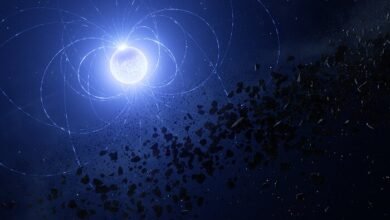
WASP-121 b is not alone in having a disturbed atmosphere. It and other planets, including WASP-69 b and KELT-9 b, appear to have puffed-up atmospheres and cometlike tails. These form when high-energy radiation from the host stars knocks gas particles off the planets and into space.
Pear-shaped exoplanets are a different matter. Astronomers have found nothing to suggest that such planets exist to the degree the term implies. Other terrestrial planets probably have deformations similar to Earth’s, or perhaps somewhat larger. Even so, from a great distance such a world would still look essentially spherical.
This explanation was originally published online on October 24, 2020, and appeared in the October 2020 issue of Astronomy magazine as a response to a reader’s question about whether planets around other stars could take oval or pear shapes.
Source: www.astronomy.com