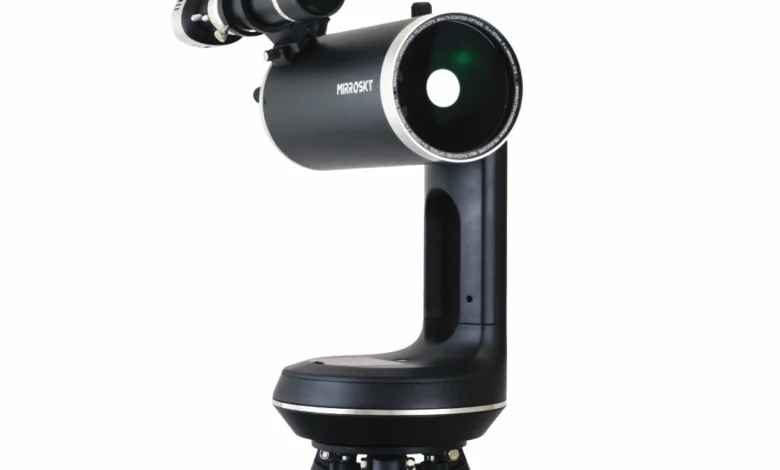
Spectrum Optics has put a conventional eyepiece telescope and a smart imaging system on the same mount with the SkyPilot 127 (SP127), a $999 instrument that pairs a 5-inch (127 mm) f/15 Maksutov-Cassegrain with an app-controlled guide scope and camera. Contributing Editor Phil Harrington, who tested a sample unit supplied by the company, describes it as an unusual entry in a smart telescope market built mostly around screen-based viewing.
Two telescopes on one mount
The SP127 looks like a standard catadioptric on a motorized alt-azimuth mount. What appears to be a finder scope is actually a 2.1-inch (53 mm) f/4 ED refractor with a digital camera attached. That second tube handles plate solving to determine the telescope’s position, slews to selected targets, maintains tracking, and captures images. Spectrum Optics uses the same camera and refractor in its separately sold SPi53 Smart Telescope.
The camera uses a Sony IMX662 color CMOS sensor with 2.9-micrometer pixels and a 1920×1080 resolution, and it has 64 GB of onboard storage. Operation runs through the MirroSky app for iOS and Android, which handles target selection, image capture, live stacking, and display. The camera supports dual-band Wi-Fi at 2.4 and 5 GHz.
The Maksutov is reserved mainly for visual observing. Its optical tube weighs about 6.5 pounds (2.95 kg), measures 14.6 inches (370 mm) long, and has a 1,900 mm focal length. A Vixen-style dovetail allows it to be removed from the mount. The assembled instrument weighs about 26 pounds (11.8 kg), and the mount’s payload capacity is 9 pounds (4 kg).
The package includes a 25 mm Plössl eyepiece, a 90° 1¼-inch star diagonal, a screw-on visual back, a steel-leg tripod, cables, an AC adapter, and a Bahtinov mask for focusing the guide scope. The camera nosepiece accepts standard 1¼-inch filters. Power can come from eight user-supplied AA batteries, an external 12-volt source, or the AC adapter.
The included camera images through the 53 mm refractor, not the Maksutov. Spectrum Optics advises using a separate camera on the Maksutov, because its long focal length and narrow field do not suit the plate-solving system. Harrington nonetheless shot the Moon by holding his iPhone to the eyepiece.
Performance in testing
Harrington had the scope assembled in under half an hour using the paper manual, after aligning the guide scope with the Maksutov in daylight. The system initializes using onboard sensors plus date, time, and location data from the connected device. He found the app easy to navigate and target acquisition quick and accurate, with objects consistently centered. The app includes guided tours and a database of more than 100,000 stars, solar system objects, and deep-sky targets.
In use, the guide scope sends the mount to a chosen target and tracks it while the observer looks through the Maksutov and the app stacks images. Harrington cautions that bumping the instrument at the eyepiece blurs the image being recorded. Tracking was accurate for visual work and short exposures, though longer exposures on an alt-azimuth mount can show field rotation at the edges.
Visually, the Moon appeared sharp, with crater walls and rilles clearly defined. In moments of steady seeing, the scope picked out a few craterlets on the floor of Plato and resolved Schröter’s Valley. On Jupiter, Harrington saw multiple cloud bands, the Great Red Spot, and shadows of Galilean moons. The Trapezium in the Orion Nebula looked striking, particularly with his own shorter focal length eyepieces. Collimation held after eyepiece changes and refocusing.
Through the guide scope, the app lets users adjust gain, exposure length, frame count, and dark frames. The Orion Nebula showed vivid color after two minutes from a light-polluted site, even as it was setting. The Pleiades did not fit entirely within the roughly 1.6° by 0.9° field. Harrington also imaged the Horsehead Nebula, the Whirlpool Galaxy, and the Great Globular Cluster in Hercules, with post-processing in tools such as PixInsight, GIMP, and Photoshop bringing out more detail than the small aperture might suggest.
Harrington concludes that the SP127 suits observers who still want to look through an eyepiece but value app-driven targeting and imaging.
Source: www.astronomy.com