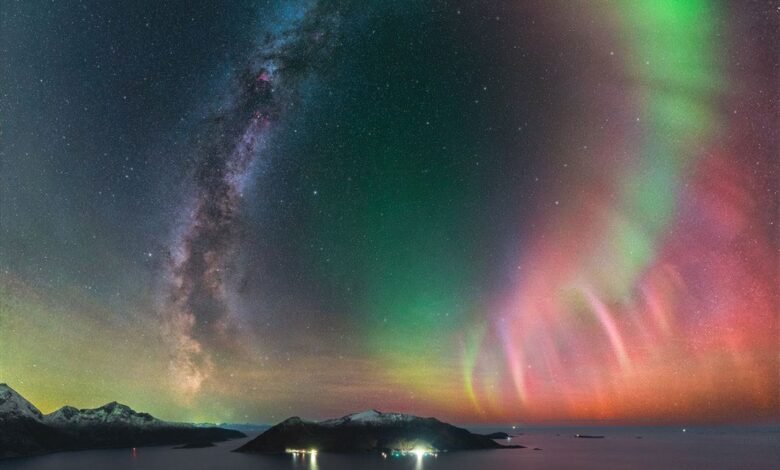
A photograph taken from northern Norway shows two enormous arches spanning the night sky: the central band of the Milky Way and a ribbon of aurora. The two are unrelated, and their alignment in the frame is a matter of chance. The image was captured roughly a month before it was published, on Kvaløya in northern Norway, and was presented as an astronomy picture with an accompanying explanation.
Two arches, very different origins
The arch on the left is the central band of the Milky Way Galaxy, a system of stars, gas and dust that is far older than Earth and lies at great distance. The arch on the right is an aurora, a feature only hours old that formed close by, in Earth’s upper atmosphere. Auroras are made of energized atoms and molecules.
The contrast in scale and age is large. One structure belongs to the galaxy as a whole. The other is a short-lived atmospheric display that happened to line up with it from the photographer’s vantage point.
The Sun as the link
The two features do share a connection through the Sun. It is a member of the Milky Way, and it also ejects the energetic particles that produce auroras on Earth. So the galactic arch and the auroral arch both trace back, in different ways, to the same star.
Objects in the background
Other celestial objects appear in the scene. The Big Dipper lies far behind the middle of the auroral arch. Farther away still is the Andromeda galaxy, visible as a bright spot near the top of the frame, just left of center.
Because of the superposition, the image shows objects at very different distances in a single view: an atmospheric glow in Earth’s upper atmosphere, stars of the Big Dipper, the Milky Way’s central band, and the more distant Andromeda galaxy.
Source: science.nasa.gov