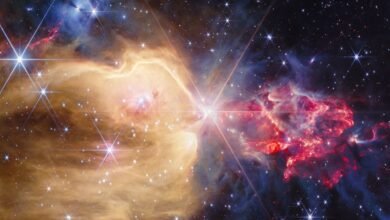
New observations from NASA’s James Webb Space Telescope (JWST) link powerful gas outflows driven by supermassive black holes to the rapid shutdown of star formation in massive galaxies. The findings, covering the period known as Cosmic Noon, suggest that galaxy-scale processes may help decide whether a galaxy keeps producing the stars and planetary systems that could host life.
The results appear in a new paper in the journal Astrophysics and Space Science. Cosmic Noon spans roughly 8 to 12 billion years ago, when the number of stars forming per unit volume in the universe reached its peak.
How outflows starve galaxies of star-forming gas
Outflows are large-scale movements of gas from the inside of a galaxy to the outside. They are usually caused by supernovae or by energetic outbursts from supermassive black holes. Galaxies are normally rich in gas, and once the gas is cold enough it collapses under its own weight into dense clouds where stars form. An outflow that removes a large share of that gas leaves less material for new stars.
Rebecca Davies, the paper’s lead author and an astrophysicist at Swinburne University of Technology in Melbourne, Australia, said that growing black holes at galactic centers drive winds that blow away gas that would otherwise form stars. JWST allows astronomers to measure how much cold, star-forming gas is being ejected. Sirio Belli, an associate professor at the University of Bologna in Italy and a co-author, said the observations show outflows to be more abundant and more powerful than previously thought. He concluded that they strongly influence how galaxies evolve.
Davies explained that quenching can occur in two ways. A galaxy may run out of gas, or the gas may be too hot or turbulent to collapse into stars. Belli noted that one possibility is that the central black hole releases enough energy to remove or heat the gas.
An unresolved question
Outflows are common in massive galaxies at Cosmic Noon, but most of those galaxies are not being quenched. According to Davies, the outflows mostly keep them in equilibrium, preventing them from turning all their gas into stars too quickly. What triggers the outflows powerful enough to shut down star formation remains a key open question. Davies named galaxy mergers and radio jets launched by central black holes as possible triggers.
As massive galaxies age, their active galactic nuclei generally become quieter. The Milky Way’s black hole, Sagittarius A*, fits that pattern. Davies said it had a major flare a few million years ago and smaller outbursts only a century or two ago, and it still flickers almost daily as hot gas swirls just outside it.
Implications for habitable worlds
Belli said that when a galaxy is quenched, the formation of new stars and planets shuts down, which strongly affects the chances of habitable systems developing. Had the Milky Way been quenched at Cosmic Noon, it would probably have formed few new stars over the past 10 billion years. The solar system, which is about 5 billion years old, would not exist.
Too much star formation can also cause problems. Belli pointed to the large number of stellar explosions that could harm planetary habitability. He added that the connection between galaxy-scale processes and the habitability of planetary systems is only now beginning to be investigated.
Source: www.universetoday.com