The European-Japanese BepiColombo mission is scheduled to fire its thrusters on Saturday, November 21, starting a series of burns meant to place it in orbit around Mercury. If the maneuvers succeed, BepiColombo will be the second spacecraft to orbit the innermost planet, after NASA’s Messenger.
Orbit insertion comes after an eight-year journey that included flybys of Earth, Venus and Mercury, and a delay of nearly a year caused by an electrical problem affecting the spacecraft’s ion thrusters. Capture is only the first stage of the arrival sequence. The stacked spacecraft starts in an orbit of 590 by 11,640 kilometers (367 by 7,233 miles), and five precisely timed burns must lower it. On December 9–10, ESA’s Mercury Planetary Orbiter (MPO) and JAXA’s Mercury Magnetospheric Orbiter (Mio) are due to separate.
A thermal risk at separation
Mercury’s closeness to the Sun makes thermal protection a central concern. Each separation, including the jettisoning of the Mercury Transfer Module in early September, leaves openings in the spacecraft’s coverings that have to close afterward. Ignacio Tanco of ESA’s Inner Solar System Missions Unit said a failure to close would cause a serious problem, with the severity depending on how it failed. ESA mission manager Santa Martinez noted that solar radiation at Mercury can be ten times what Earth receives, and that temperatures are extreme. She said contingency procedures for several scenarios have been rehearsed.
What the orbiters will study
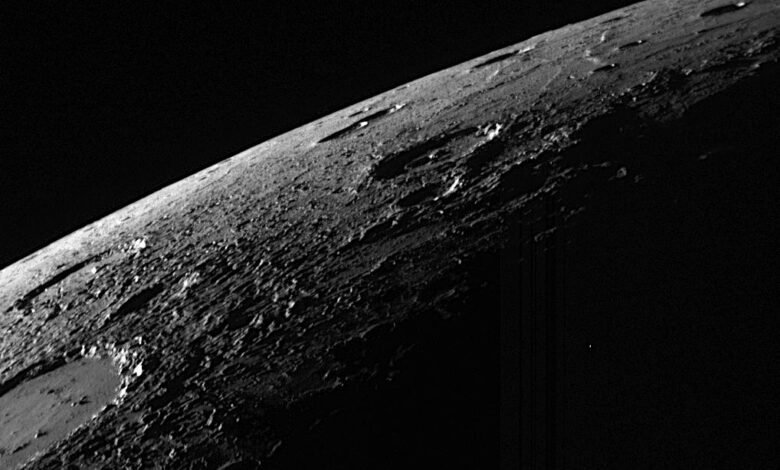
MPO and Mio are designed to examine Mercury’s interior, magnetic field, polar ice and surface from complementary positions. Lead project scientist Geraint Jones of ESA said Mercury is more massive than expected for its size. The leading explanation is that a very large impact long ago stripped away its outer mantle. Better knowledge of the interior should clarify the planet’s history.
Mercury also has a global magnetic field, which makes it the only rocky planet other than Earth with one, despite being only slightly larger than the Moon. MPO’s radio link, accelerometer, laser altimeter and magnetometer will help probe the interior and the process that generates the field.
Radar observations and Messenger data indicate water ice in permanently shadowed craters near both poles. Messenger’s orbit covered the north well but the south poorly, and Jones said BepiColombo’s orbit should improve southern coverage. A modeling study published in May in the Journal of Geophysical Research: Planets, co-led by Parvathy Prem of the Johns Hopkins Applied Physics Laboratory, suggests that a single large impact comparable to the one that formed Hokusai crater could have spread water vapor around the planet, with much of it ending up trapped in polar craters.
MPO may also image Messenger’s impact site. The spacecraft hit Mercury in 2015 at about 3.9 kilometers per second (8,700 mph), and NASA estimated it left a crater about 16 meters (52 feet) wide in Suisei Planitia.
Two spacecraft, two vantage points
MPO will orbit as close as 480 kilometers from the surface and carries cameras, spectrometers, the altimeter and a radio science experiment. Mio spins at about 15 revolutions per minute and reaches out to roughly 11,000 kilometers to study the magnetic environment. Together they can measure the magnetosphere from inside and outside at once, which a single spacecraft cannot do.
Once in their final orbits, the spacecraft will enter commissioning, which runs through March. Mio must extend 15-meter wire antennas and 5-meter magnetometer booms, a process expected to take about a month. The science phase is scheduled to begin April 6, 2027, more than eight years after the October 20, 2018 launch. ESA has not said how soon images will be released to the public. Jones said that question would go to a science team meeting in Lisbon this month.
Source: skyandtelescope.org