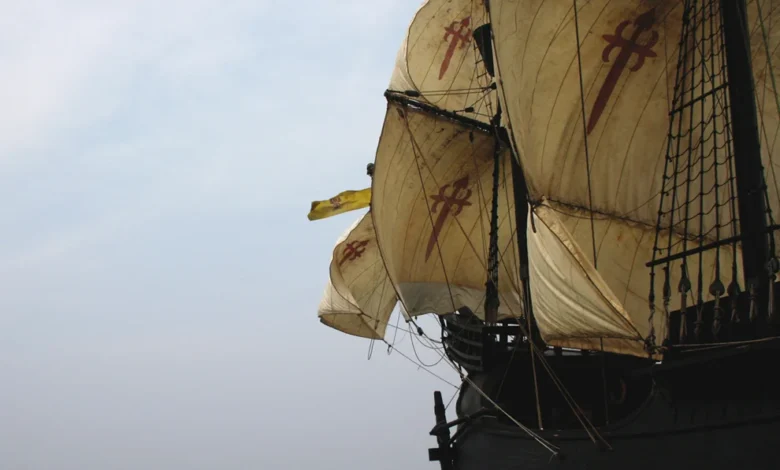
The space economy has attracted years of investment and promotion, yet offworld mining, in-space manufacturing, and space tourism have so far delivered little in the way of returns. History suggests why that matters. Exploration beyond the known world has tended to move fastest when commerce pays for it, and the 16th-century spice trade is one of the clearest examples.
Why Spices Sent Ships Around the World
In the late 15th century, cloves, nutmeg, and ginger reached European elites by way of overland routes, including the Silk Road, which ran from the Black Sea and Mediterranean through northern India to China. Camel caravans moved the goods in small quantities, and a long chain of middlemen pushed prices steadily higher.
The supply was also geographically narrow. Author Lewis Dartnell, in his 2019 book “Origins: How the Earth Shaped Human History,” notes that cloves grew in the volcanic soils of only a few small islands in the northern Moluccas, in what is now Indonesia. Nutmeg grew on just nine tiny islands, the Bandas, farther south.
Portugal and Spain competed to find a sea route that would bypass the intermediaries and carry spices directly in cargo ships. Ferdinand Magellan, a Portuguese explorer from a family of minor nobility, persuaded Spain’s King Charles V that the eastern riches could be reached by sailing west, according to Romeu Gaspar’s 2026 book “The Revolution of Magellan: How 500-Year-Old Rocket Science Changed the World.” Magellan died during the voyage, but some of his crew completed the first circumnavigation of the globe.
A High-Value, Low-Mass Cargo
Dried spices suited long-haul shipping. John Keay, in his 2005 book “The Spice Route: A History,” describes them as lightweight, valuable, and reasonably imperishable. Keay reports that cargo docked at Lisbon in 1515 returned 700 percent. By 1520, Dartnell writes, the spice trade supplied 40 percent of the Portuguese Crown’s revenue. The Dutch later traded Manhattan for the nutmeg-rich island of Run.
The Space Parallel
The modern equivalent would be a commercial operation that extracts and processes rare minerals from the Moon, Mars, or accessible Main Belt asteroids, then returns them to Earth or low-Earth orbit at a profit. Apollo 17 astronaut and geologist Harrison “Jack” Schmitt has long advocated mining helium-3 on the Moon. Human exploration of the solar system is likely to lag until cislunar space can be made economically viable, the argument goes, because scientific innovation has usually followed the pursuit of large profits.
Pete Worden, a retired U.S. Air Force brigadier general, astrophysicist, chairman of the Breakthrough Prize Foundation, and Laureate Professor at the University of Arizona, said in an email that a lasting commercial reason to work in space could give human space science the transportation and infrastructure it lacks. Worden directed NASA Ames Research Center from 2006 to 2015.
Robots First, Commercial Partners Next
For at least the next 50 years, Worden suggests, robotic missions are likely the best route for scientific exploration. He would give commercial companies a larger role in developing and operating human spaceflight systems. He also argues that NASA should return to the emphasis of its predecessor, the National Advisory Committee for Aeronautics (NACA), on research and technology development that industry and scientists can build on. If commercial space transportation becomes routine, he says, agencies such as the National Science Foundation could fund research that uses it.
Worden also points to the political and budgetary turbulence behind NASA’s Moon and Mars plans. Over the past 30 years, those plans have had to survive changes in administrations, budgets, and priorities, he says. When a program needs agreement from too many people, sensible risk-taking becomes harder.
The argument rests on a historical analogy, not a forecast. Spaceflight beyond low-Earth orbit would need to become commercially viable in the way the spice trade was before it could drive sustained expansion.
Source: www.universetoday.com