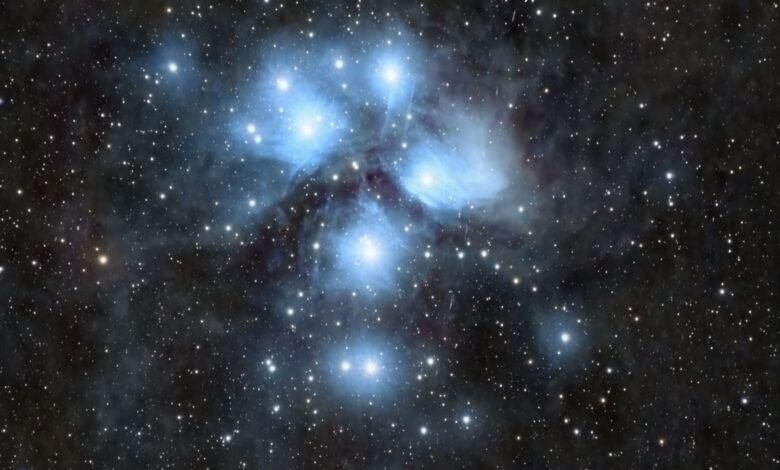
The Pleiades star cluster, also known as the Seven Sisters and catalogued as Messier 45 (M45), returns to the evening sky each northern autumn. It is one of the few deep-sky objects that nearly everyone on Earth can see. The cluster is visible from the North Pole and from latitudes south of the tip of South America, where it appears as a small, misty dipper of stars.
A family of stars born together
The Pleiades is an open cluster, a gravitationally bound group of stars. Astronomers say its members formed from the same cloud of gas and dust about 100 million years ago. The cluster lies roughly 440 light-years away and moves through space at about 25 miles (40 km) per second. Many of its stars shine hundreds of times more brightly than the sun.
Astronomers have recently found that the cluster has more than 3,000 sibling stars that came from the same giant molecular cloud.
Finding M45 from Orion
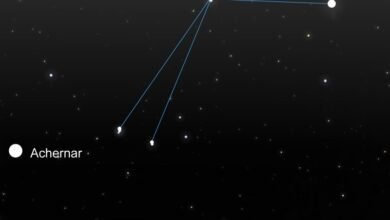
Orion the Hunter is the easiest guide. Extend a line through the three stars of Orion’s Belt to the V-shaped Face of Taurus the Bull. The bright star within the V is Aldebaran, the Bull’s Eye. Continue a little farther and you reach the Pleiades, which mark the Bull’s Shoulder.
In November, these objects rise in the east by mid to late evening, and they appear earlier as the months pass. The Pleiades shine from dusk to dawn in November, and the cluster remains visible in the evening sky until April.
The name Aldebaran comes from an Arabic word meaning follower, probably a reference to the star’s apparent chase of the Pleiades across the sky. In most places the cluster rises and sets before Aldebaran. At far southern latitudes such as Tierra del Fuego, the order reverses at rising, and the Pleiades come up shortly after Aldebaran.
Myth, Halloween and the lost sister
Cultures around the world have woven stories around the cluster. In Greek mythology, the Pleiades were the seven daughters of the Titan Atlas and the oceanid Pleione: Maia, Electra, Alcyone, Taygete, Asterope, Celaeno and Merope. A Polynesian legend says the cluster was once a single star, the brightest in the sky, which the god Tane shattered because he disliked its boasting. Halloween is also traditionally traced to a Druid rite timed to the cluster’s midnight culmination, its highest point in the sky.
Most observers under a dark rural sky count six stars, not seven. Astronomer Robert Burnham Jr. found tales of a lost seventh Pleiad in European, African, Asian, Indonesian, Native American and Aboriginal Australian traditions. He suggested the legend might have a factual basis. Pleione, the seventh-brightest star in the cluster, is a complex shell star that undergoes changes that can alter its brightness.
Some people with exceptional eyesight report seeing many more stars, with claims reaching 20. Agnes Clerke, a late-19th-century astronomer and writer, reported that Michael Maestlin, Johannes Kepler’s mentor, mapped 11 Pleiades stars before the telescope was invented.
Seeing beyond six or seven stars takes good vision, a dark, moonless sky and patience. Stephen O’Meara has claimed that eyes dark-adapted for 30 minutes are six times more sensitive to light than eyes adapted for 15 minutes. Binoculars or a telescope are the surest way to reveal additional stars.
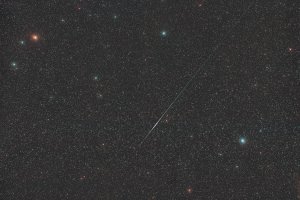
The cluster is also a popular astrophotography target. In November 2026, Mohammed Abdallah of Suez, Egypt, combined nearly 20 hours of observations into an image of the cluster. Asteroid 83 Beatrix crossed the same field during his imaging session.
Source: earthsky.org