


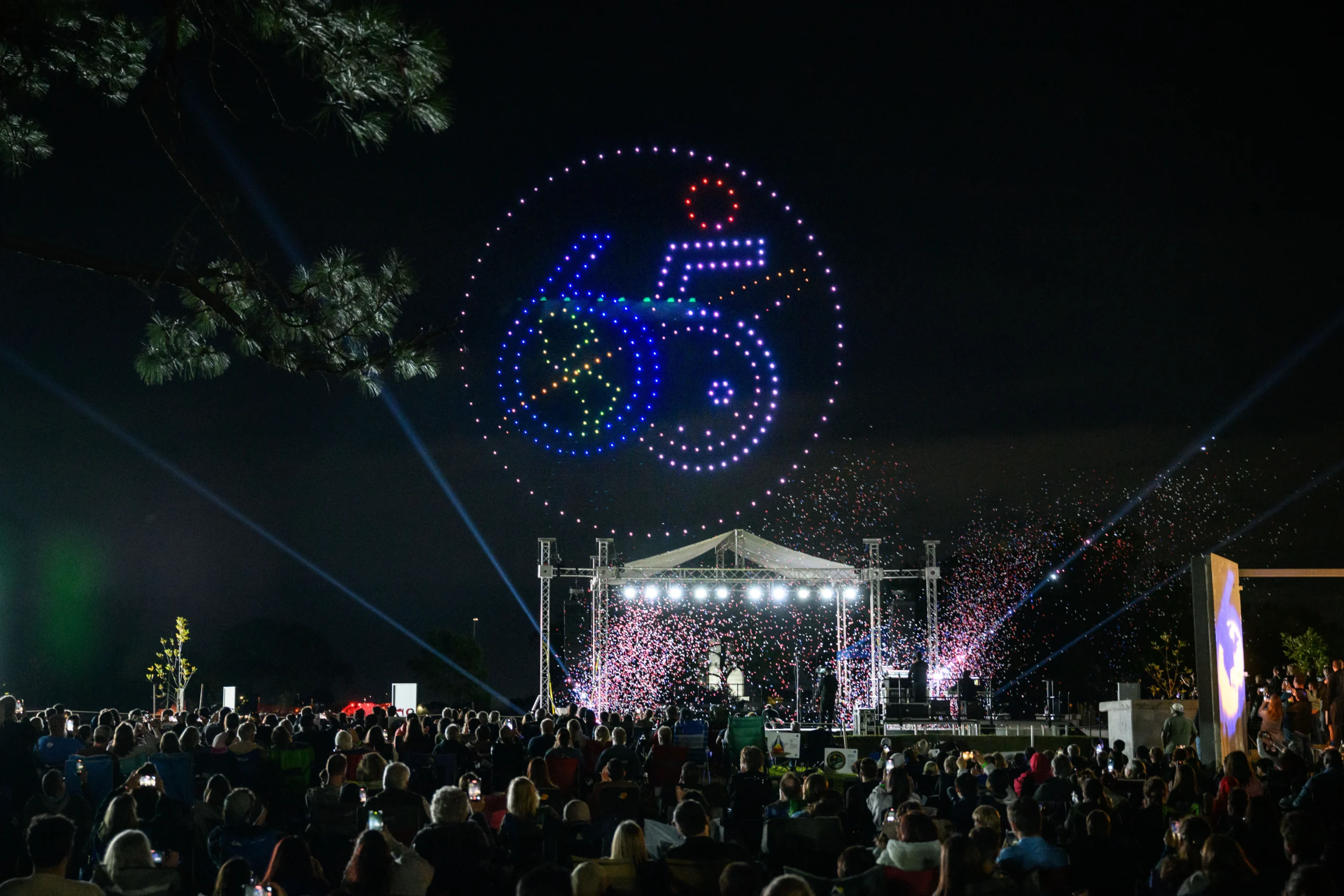
NASA’s Johnson Space Center in Houston is marking 65 years of human spaceflight operations. Its teams are now preparing for the agency’s return to the lunar surface under the Artemis program and for a longer-term presence at the Moon. Johnson is home to NASA’s Orion and Moon Base programs. It also supports International Space Station operations, astronaut training, spacecraft development, mission operations and human health research.
From Gemini to Apollo
The Manned Spacecraft Center, as Johnson was first called, officially opened on Nov. 1, 1961. NASA had flown two suborbital Mercury missions by then, and most Mercury work stayed at Cape Canaveral, Florida. Project Gemini was the first program based in Houston, operating from temporary leased facilities while the Clear Lake campus was built.
The new Mission Control Center became NASA’s primary flight control center in June 1965 with Gemini IV, which included the first American spacewalk. Houston oversaw the remaining eight Gemini missions before the program gave way to Apollo. After the Apollo 1 fire in January 1967, teams at the center applied lessons learned to make the spacecraft safer. Crewed flights resumed in October 1968, and Houston managers devised the plan to send Apollo 8 around the Moon, which flew in December 1968.
Apollo 11 astronauts Neil Armstrong and Edwin “Buzz” Aldrin landed seven months later. Their first transmission after arriving on the surface began by addressing Houston. Five more landings ended Apollo in December 1972.
Apollo samples were first analyzed at the center’s Lunar Receiving Laboratory. That building was demolished in March 2024, and a Lunar Receiving Park honoring it was dedicated in 2026. Johnson’s Astromaterials Research and Exploration Science (ARES) division still analyzes and curates the Apollo collection at the Lunar Sample Laboratory Facility.
Skylab, Shuttle and the space station
Skylab, the first U.S. space station, lost its thermal shield and one solar array during its May 1973 launch, and the other array jammed. Within 10 days, Houston engineers designed and built a sun shield and developed procedures to free the array. The first crew then carried out extensive repairs in orbit. Three missions of 28, 59 and 84 days produced more research than planned and gave mission controllers round-the-clock experience with long-duration flights.
In July 1975, American astronauts and Soviet cosmonauts met in orbit for the first time during the Apollo-Soyuz Test Project, after joint training in Houston and Moscow. The space shuttle received formal approval in 1972. Columbia launched in April 1981, and the program went on to fly 135 missions carrying 355 people from 16 nations. It ended with STS-135 in July 2011.
Johnson manages the International Space Station program. The first element launched in November 1998, and the first U.S. element, the Unity module, followed a month later. The first expedition crew arrived Nov. 2, 2000. Since then, 298 people from 26 countries have visited the station, which has hosted more than 4,000 experiments and educational activities. Johnson’s Mission Control Center, Space Vehicle Mockup Facility, Neutral Buoyancy Laboratory and Human Research Program support crews and research on the station.
Artemis and Moon Base
Artemis II was the first crewed flight of Orion. The four-person crew launched April 1 on a trip around the Moon lasting nearly 10 days. At its farthest point, Orion was 252,756 miles from Earth, farther than any humans had traveled before.
Artemis III is planned to test integrated operations in low Earth orbit between Orion and test versions of one or both commercial human landing systems being developed by SpaceX and Blue Origin. Astronauts will demonstrate the rendezvous and docking needed to transfer crews between vehicles. The lunar landing is planned for Artemis IV.
NASA’s Moon Base Program is planning a phased effort near the lunar South Pole. The first phase covers robotic exploration, technology demonstrations and preparations for surface operations. Later phases will add infrastructure for astronauts living and working there, along with lunar terrain vehicles for longer-range exploration, equipment transport and science.
Source: www.nasa.gov