


Two decades before the first Cosmic Call and forty years before a Japanese team pointed a radio antenna back at the target star, a pair of astronomers sent a multi-page message from California toward Altair. That 1983 transmission, the Message to Altair, and the Cosmic Call broadcasts of 1999 and 2003 are among the more ambitious efforts in the history of Messaging Extraterrestrial Intelligence (METI). All of them built on the template set by the 1974 Arecibo Message.
The Message to Altair
Astronomers Masaaki Morimoto and Hisashi Hirabayashi used the Stanford Dish radio telescope at Stanford University to send the message on August 15, 1983. It was produced with the Japanese publication Weekly Shonen Jump to mark the magazine’s 15th anniversary. The target was Altair, an A-type star 16.7 light-years away that figures in the Tanabata legend as the deity Hikoboshi.
Unlike Arecibo’s single pictograph, the message ran to several pages. The first covered mathematics: the numbers 1 to 12, prime numbers, powers of 3, symbols for addition and multiplication, and the elements hydrogen, helium, carbon, nitrogen and oxygen. It also listed molecules relevant to prebiotic chemistry, including hydroxide, water, nitrous oxide, formaldehyde and hydrogen cyanide, along with their wavelengths.
The second page described the Solar System, and the third and fourth showed DNA’s chemical formulae, structure and replication. Drawings of life forms arranged to suggest evolution followed, running from primitive life through jellyfish, fish, amphibians, lizards, early mammals and apes to humans. A man, a woman and two children appear in a layout echoing the Pioneer Plaques, and a close-up of a waving woman follows. The final page gave transmission parameters and ended with the word “toast” in Japanese and English, plus the formula for ethanol.
At Altair’s distance, the message would have arrived around 2000, and a reply could return by 2017. In 2023, Hyogo University astronomer Shin-ya Narusawa, who knew Morimoto, asked the Japan Aerospace Exploration Agency (JAXA) to help look for one. JAXA observed Altair for an hour from the Usuda Space Observatory’s antenna at 10 p.m. on August 22, 2023, which was Tanabata in the old Japanese calendar. No signals were detected. Narusawa said he plans to keep observing and to work with other institutions.
The Cosmic Call broadcasts
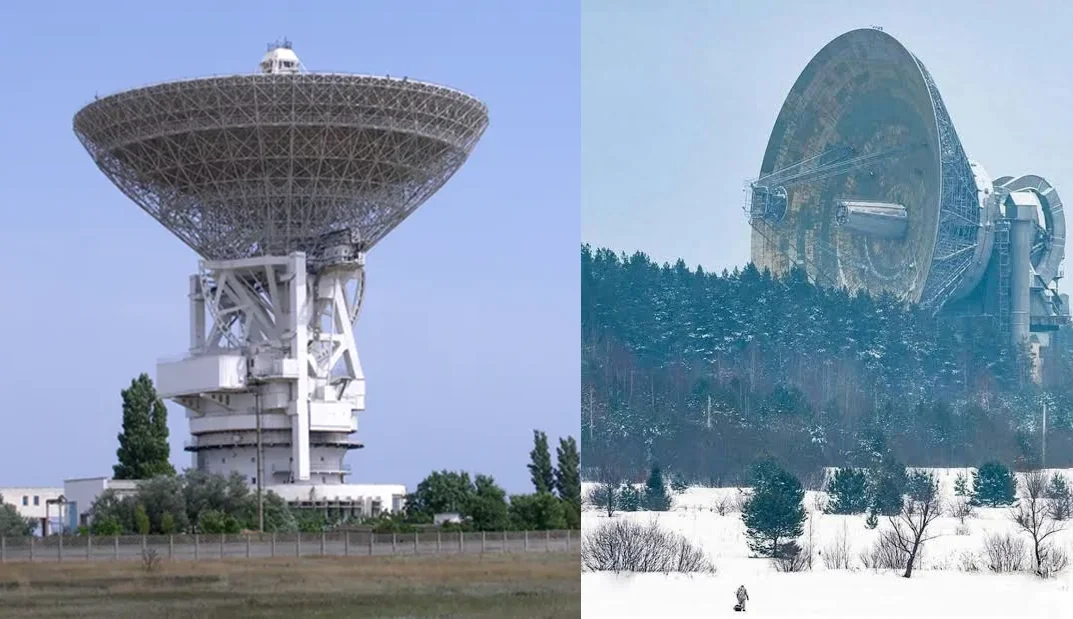
The Cosmic Call messages were transmitted with the RT-70 dish of the Evpatoria Planetary Radar, a Soviet-era deep-space communications and radio astronomy facility in Crimea. Alexander Zaitsev, the Russian radio engineer and SETI researcher who coined the term METI in a 2006 paper, helped organize the effort. The project was crowdsourced, involving the Texas startup Team Encounter, Canadian astrophysicist Yvan Dutil, Russian scientists and Eastern European radio engineers.
Dutil and Stéphane Dumas wrote a primer inspired by Hans Freudenthal’s 1960 book on Lincos, a language designed to be understood by an extraterrestrial intelligence. It used pictograms for mathematics, physics, including the hydrogen spectrum, and related concepts. Team Encounter’s Richard Braastad contributed a pictogram series that used mathematical symbols to describe a solar sail the company was developing, including its dimensions, payload, trajectory and projected launch time. The 1999 broadcast also carried the Arecibo Message, a Team Encounter staff message and a section composed with public input.
Cosmic Call 1 was split into four sessions totaling 40 hours, each aimed at a Sun-like G-type star. Targets included 16 Cygni A on May 24, 1999, and 15 Sagittae and HD 178428 on June 30, 1999. The scientific sections were sent three times at 100 bits per second, followed by the public section once at 2,000 bits per second.
The 2003 broadcast used an updated Lincos primer from Dutil and Dumas, the Arecibo Message, a Bilingual Image Glossary and the same public section. Its targets were GJ 49, Gliese 208, 55 Cancri, HD 10307 and 47 Ursae Majoris, at distances of 32 to 45.3 light-years.
The Cosmic Calls were the most ambitious public SETI/METI effort mounted to that point. Team Encounter later went bankrupt, but its messages set a precedent for later projects, several of which involved Zaitsev. His work with colleagues led to the founding of METI International by 2008.
Source: www.universetoday.com