


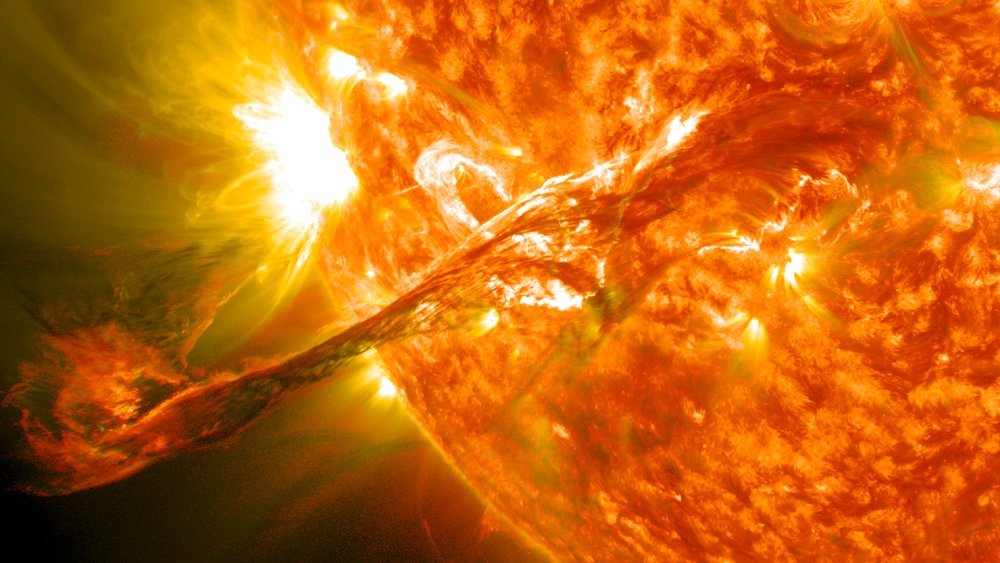
A new set of global 3D simulations has followed coronal mass ejections (CMEs) from their origin on the Sun through their collision and merger. The result is the first single model to cover the whole sequence of CME “cannibalism,” in which a faster eruption overtakes a slower one and the two combine. The work was led by Lijun Cai of the Harbin Institute of Technology and published in The Astrophysical Journal Letters.
CMEs are tangled clouds of plasma and magnetic field that the Sun expels into space. Near the peak of its activity cycle, the Sun can produce several per day. Some are launched from the same region, and these tend to share a similar trajectory and magnetic configuration. That makes them likely candidates to merge, potentially producing a stronger and more destructive event than any one of them alone.
Bridging two kinds of models
Earlier simulations covered only parts of this process. Some launched multiple CMEs from one area of the Sun but stopped before the eruptions caught up with each other. Others set CMEs on a collision course and began the simulation well after the ejections, so the origin of the eruptions was not modeled. Cai and colleagues combined the two approaches in global magnetohydrodynamic simulations that run from eruption to merger.
Three eruptions, three speeds
The team launched three CMEs in quick succession from a single region of the photosphere, the Sun’s visible surface. Each eruption was driven by photospheric shearing. In this process, plasma motions shift the footpoints of magnetic field lines that arch into the corona, the Sun’s outer atmosphere. Magnetic energy accumulates until it is released as a CME.
Each eruption moved faster than the one before it. The shocks of the first, second, and third CMEs reached 770, 2,480, and 3,230 kilometers per second, respectively. The authors attribute this to two factors. The first CME reduced the background plasma density by an order of magnitude, so later eruptions traveled through a more rarefied corona. In addition, the second and third CMEs were driven by a larger release of magnetic energy than the first, which gave them more kinetic energy from the outset.
How the merger unfolds
When one CME reaches another, a thin layer of electric current forms between them. Within this layer, the magnetic field lines of the two eruptions interact and rearrange through magnetic reconnection, joining the two magnetic structures into one. Plasma from both eruptions can then mix. The researchers also generated synthetic white-light images, which show the three CMEs coalescing.
The simulations indicate why successive CMEs from the same solar region can overtake one another and how magnetic interactions allow them to unite.
The team’s next step is to extend the simulations from the Sun all the way to Earth. The aim is to determine how mergers change the strength of a CME’s effects at Earth.
The study is titled “A Global Magnetohydrodynamic Simulation of the Birth and Cannibalism of Homologous Coronal Mass Ejections” (ApJL 1011, L46; doi:10.3847/2041-8213/aeb88d).
Source: aasnova.org