


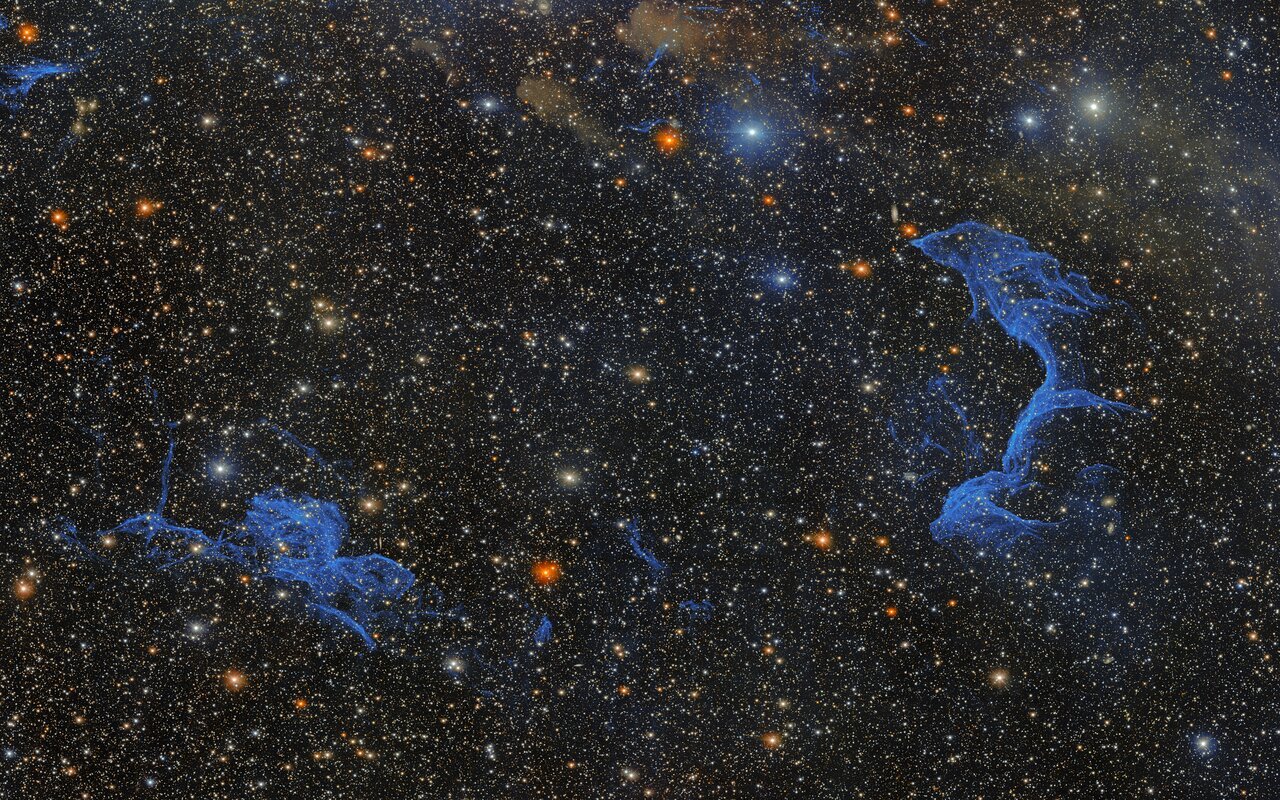
A new image from the Dark Energy Camera shows the supernova remnant SNR G295.5+09.7, nicknamed the Betta Fish Nebula, in more detail than any previous view. NSF NOIRLab released the image. The nebula’s blue filaments resemble the flowing tails of betta fish. The remnant may never have been imaged by a professional observatory before, which would make this the first image of its kind.
Imaging the remnant with DECam
The data were collected with the 570-megapixel Dark Energy Camera (DECam), mounted on the U.S. National Science Foundation Víctor M. Blanco 4-meter Telescope at Cerro Tololo Inter-American Observatory (CTIO) in Chile. CTIO is a program of NSF NOIRLab. DECam was fabricated with U.S. Department of Energy funding and was built and tested at DOE’s Fermilab. It was designed for the Dark Energy Survey, and its wide field of view suits large nebulae and the star fields around them.
The observations are part of the NOIRLab Legacy Imaging Program. That program continues the Gemini Legacy Imaging Program, which began at the International Gemini Observatory in 2002. It sets aside dedicated observing time on NOIRLab telescopes to collect data intended for color images to share with the public.
What the nebula is
As the designation indicates, SNR G295.5+09.7 is a supernova remnant, left behind when a star many times more massive than the Sun exploded. The blast expelled the star’s outer layers, and the ejected material expanded into the interstellar medium. As it collided with surrounding gas, it made that gas glow, producing the blue ribbons in the image.
The rest of the star collapsed under its own gravity. Collapse stopped when a neutron star formed, and NOIRLab says this object sits inside the nebula’s outer shell. Neutron stars hold about 1.4 times the Sun’s mass in a sphere roughly 20 kilometers (12 miles) across, small enough to fit within the city of Tucson, Arizona, where NOIRLab is headquartered. Had the collapse continued, the result would have been a black hole.
Location and background objects
The Betta Fish Nebula lies almost 6,800 light-years away in Centaurus, a constellation visible from the Southern Hemisphere. It is within the Carina–Sagittarius arm of the Milky Way. Thousands of stars from that arm fill the background of the image, and some galaxies beyond the Milky Way are hidden among them. NOIRLab has invited viewers to look for them in the zoomable version of the photo.
Hazy brown patches in the background are interstellar clouds within the Milky Way. They resemble nebulae but are far more dispersed. The Solar System itself lies inside one such structure, the Local Interstellar Cloud.
About NOIRLab
NSF NOIRLab is the U.S. National Science Foundation center for ground-based optical-infrared astronomy. Besides CTIO, it operates the International Gemini Observatory, NSF Kitt Peak National Observatory, the Community Science and Data Center, and the NSF–DOE Vera C. Rubin Observatory, which it runs in cooperation with DOE’s SLAC National Accelerator Laboratory. The Association of Universities for Research in Astronomy (AURA) manages NOIRLab under a cooperative agreement with NSF.
Source: noirlab.edu