


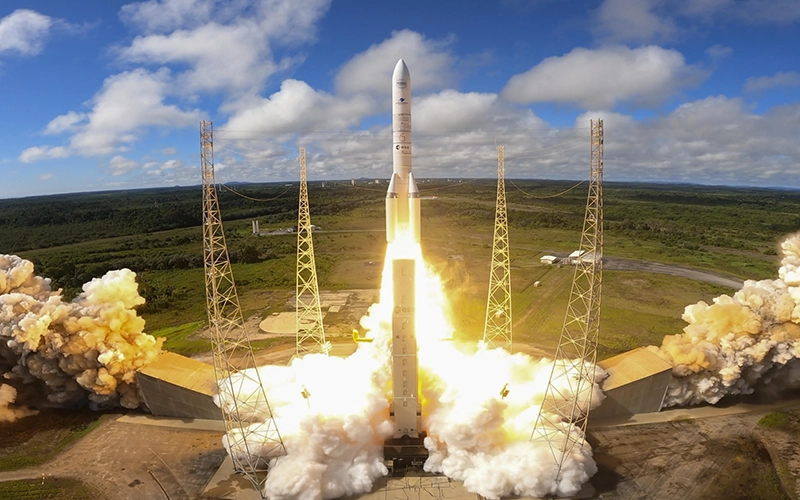
Arianespace has completed the tenth flight of its Ariane 6 rocket, placing 36 more Amazon Leo satellites into low Earth orbit. It was the first Ariane 6 launch since a turbopump issue was identified and addressed, and a final mission for 2026 is now expected on 17 December.
The rocket lifted off from the Guiana Space Centre at 11:14 UTC on 24 November, a day later than originally scheduled. A technical problem with the rocket’s ground support systems caused the delay. The mission lasted just over two hours, and all 36 satellites were released at an altitude of approximately 460 kilometres.
Amazon Leo deployment continues
This was Ariane 6’s fourth mission for Amazon in 2026. Arianespace has now launched 136 satellites for the company’s broadband internet constellation. In September, Amazon expanded its launch services agreement with the company by ordering six more flights of the Ariane 64 configuration, raising the number of missions under contract to 24.
Turbopump issue and further testing
The launch followed the discovery of a problem with one of the rocket’s turbopumps in August. The issue was reportedly resolved before this flight. According to a 19 November report by La Tribune, another engine test is planned for early December to fully validate the corrective measures.
MetOp-SG-B1 next
The next Ariane 6 mission is expected to carry the MetOp-SG-B1 weather satellite for the European meteorological satellite operator EUMETSAT. An update to ESA’s dedicated Ariane 6 page lists 17 December as the expected launch date.
If that flight goes ahead as planned, Arianespace will have flown Ariane 6 six times in 2026, up from four flights in 2025. That would still sit at the lower end of the company’s initial target of six to eight flights for the year.
Source: europeanspaceflight.com