


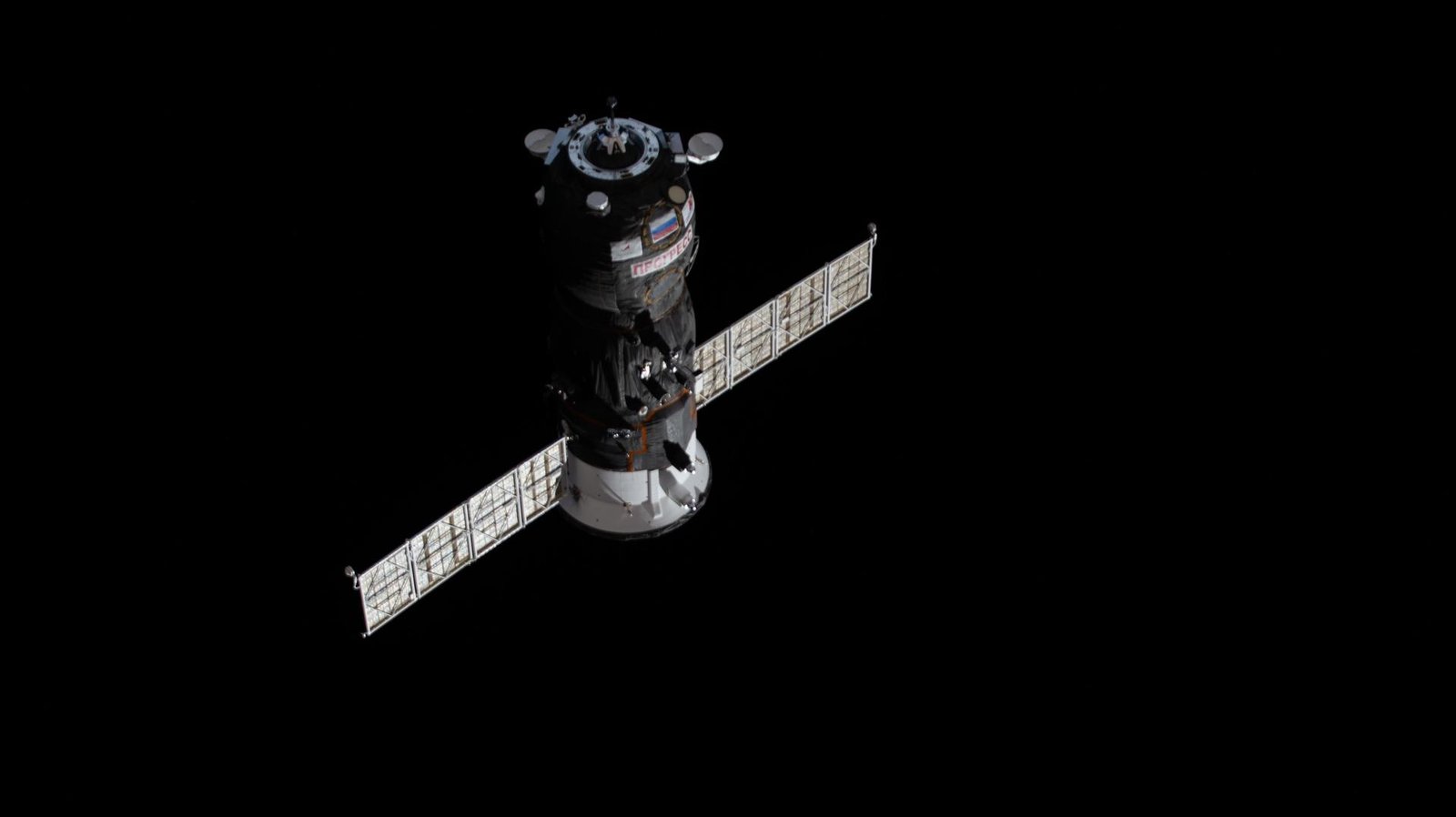
A Roscosmos Progress 97 cargo spacecraft is on its way to the International Space Station after launching at 5:17 a.m. EST from Kazakhstan. The vehicle carries about three tons of food, fuel, and supplies for the Expedition 75 crew. It is scheduled to dock automatically at the station’s Rassvet module at 7:11 a.m. on Thanksgiving Day.
A second delivery follows within days and will be the station’s last cargo mission of the year. Northrop Grumman’s Cygnus XL spacecraft is targeted to launch on a SpaceX Falcon 9 rocket no earlier than 10:47 a.m. on Sunday, Nov. 29, from Cape Canaveral Space Force Station in Florida.
Cygnus XL capture planned for Dec. 1
NASA flight engineers Jessica Watkins and Luke Delaney will operate the Canadarm2 robotic arm to capture Cygnus XL on Tuesday, Dec. 1. Ground controllers will then take over the arm remotely and maneuver the spacecraft to the Earth-facing port of the Unity module for installation.
Cygnus XL is carrying roughly 11,000 pounds of science experiments and laboratory hardware to support station operations. Among the new research are investigations of cancer cell movement, engineered muscle tissues, and DNA-inspired particles. The work is intended to benefit human health on Earth and in space.
Crew continues health research and maintenance
The seven Expedition 75 crew members spent Tuesday on life science studies and station upkeep. Watkins and Delaney began their shift by scanning each other’s internal organs with the EchoFinder-2 ultrasound device. Doctors on the ground watched in real time as augmented reality tools and artificial intelligence algorithms helped identify the organs. The two astronauts later reviewed the upcoming Cygnus XL mission, practiced robotic capture techniques, and held a pre-mission conference with flight controllers.
In the Tranquility module, flight engineers Anil Menon of NASA and Joshua Kutryk of the Canadian Space Agency maintained exercise equipment. Menon inspected, cleaned, and lubricated the advanced resistive exercise device, which simulates free weights on Earth. Kutryk inspected the COLBERT treadmill, photographed its components, and tested that it worked.
In the Roscosmos segment, cosmonauts Pyotr Dubrov and Sergey Teteryatnikov collected air samples to check for airborne bacteria and mold. They stored the samples in an incubator to see whether microbial growth develops.
Flight engineer Anna Kikina divided her day between biomedical research and life support maintenance. For a long-running Roscosmos investigation into how spaceflight affects the immune and nervous systems, she collected and stowed hair and saliva samples for preservation and analysis. She also took a timed memory test and wore a heart activity monitor.
Source: www.nasa.gov