


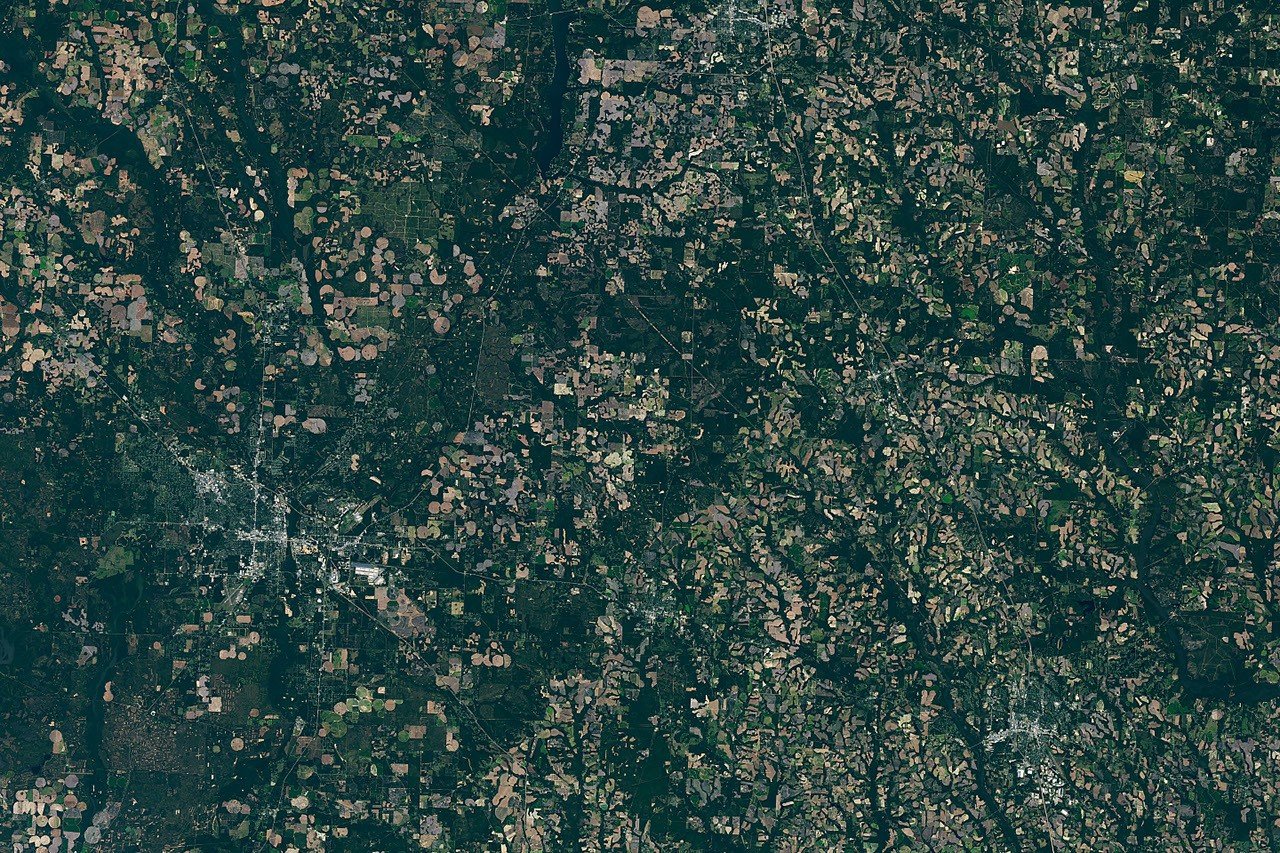
A Landsat 8 image from October 23, 2026, shows the farmland around Albany in southwest Georgia during pecan harvest season. The area is one of the state’s main pecan-growing regions, and Georgia has historically been the top pecan-producing state in the U.S. NASA’s Earth Observatory published the image, which was acquired by the satellite’s Operational Land Imager (OLI).
The scene covers Albany, in Dougherty County, and neighboring counties. Farm fields form a patchwork of green and brown, and vegetation lines the rivers, including the Flint River north and south of the city. The date falls within the typical harvest window of October into December. Pecans share the landscape with other crops, including peanuts, cotton, and corn.
Why pecans grow here
Pecans grow on Carya illinoinensis, a hickory species in the walnut family that is native to North America. Landsat observations feed into the Cropland Data Layer, an annual crop-type map of the contiguous United States produced by the USDA’s National Agricultural Statistics Service. The 2025 version shows pecan groves clustered along the Flint River in the Coastal Plain.
The trees need plenty of water, and the region’s well-drained sandy soils generally suit them. Those soils sit above the Floridan aquifer system, which growers can tap for irrigation.
From 100 acres to a national lead
In the late 1800s, Georgia had fewer than 100 acres (40 hectares) of pecan orchards. Early in the 1900s, Dougherty and Mitchell counties saw a planting boom, with thousands of acres set out and sold to investors. By the end of the 1950s, Georgia led the country in pecan output. The 1959 agricultural census recorded more than 17 million pounds.
Other states, including New Mexico and Texas, have expanded their own production in recent decades. Georgia’s orchards have also taken damage. Hurricane Michael struck in October 2018, and Hurricane Helene moved inland in September 2024. Even so, USDA figures show Georgia’s production has exceeded 100 million pounds in each of the past three years, 2023 through 2025.
Mixed conditions in 2026
This year’s growing season brought its own problem. A wet summer in parts of Georgia helped scab take hold, a fungal disease that leaves brown spots on pecan twigs, leaves, and nut shucks. Some growers still recovering from Helene, meanwhile, reported that a solid crop had returned.
The image was produced by NASA Earth Observatory’s Lauren Dauphin using Landsat data from the U.S. Geological Survey. Kathryn Hansen wrote the accompanying story.
Source: science.nasa.gov