


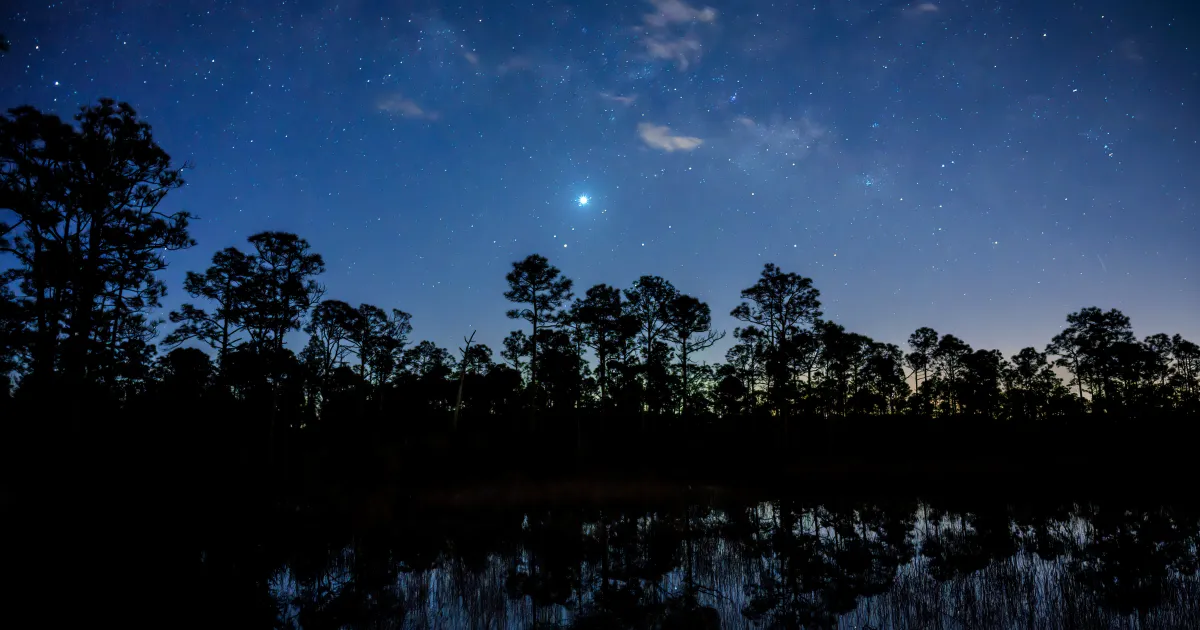
Venus reaches its greatest brilliancy on Sunday, November 29, at 2 P.M. EST, anchoring a week of morning planets, asteroid turnarounds and deep-sky targets. The planet shines at magnitude –4.9 and rises nearly three and a half hours before the Sun. Observers under very dark skies (Bortle 1 or 2) may be able to see Venus cast a faint shadow.
Venus, Mercury and a crowded Leo
An hour before sunrise, Venus stands roughly 25° high in the southeast, just to the lower left of Spica in Virgo. Mercury sits far below it, nearly 5° above the horizon at magnitude –0.7. Through a telescope, Venus is a 27%-lit crescent 40 arcseconds across. Mercury is only 6 arcseconds wide but 82% illuminated.
Mercury’s window is closing. It sinks a little each morning, and by December 5 it will be less than 2° high an hour before sunrise. Venus will hold about the same altitude at that hour all month, with its phase approaching 50% by year’s end. It should stay prominent in the morning sky through the first half of 2027.
On the morning of November 30, the waning gibbous Moon joins Jupiter, Mars and the star Regulus in Leo, beneath the Sickle asterism. Jupiter shines at magnitude –2.2 and appears 39 arcseconds across. Mars, to Jupiter’s left, is magnitude 0.4 and 8 arcseconds wide. Both planets are brightening as they head toward opposition early next year. The Moon passes 1.2° south of Jupiter at 4 A.M. EST, 1.1° south of Regulus at 10 A.M. and 3° south of Mars at 3 P.M.
Saturn’s moons and two asteroids
Saturn is high in the south around 8 P.M. and sets near 2 A.M. local time. Iapetus is passing north of the planet, which makes the 11th-magnitude moon easier to find. On November 28 it lies about 2′ northeast of Saturn. It reaches inferior conjunction, due north of the planet, on the 30th, and heads for a western elongation in late December.
Mid-8th-magnitude Titan sits about 3′ west of Saturn and will pass south of the planet on December 2. Dione, Rhea and Tethys, all around 10th magnitude, shift visibly within hours. Dione is occulted by Saturn’s southwestern limb around 12:20 A.M. EST on November 29, which falls late on the 28th in western time zones.
Two asteroids in Cetus also change direction. Pallas, at magnitude 9.0, is stationary on December 1 at 7 A.M. EST and then resumes eastward motion. It lies about 4.2° southeast of Diphda. About 5° farther south, across the border in Sculptor, is the globular cluster NGC 288, roughly 49,000 light-years away. The 7th-magnitude galaxy NGC 253, the Sculptor Galaxy, lies 1.7° northwest of it, so both fit in binoculars or a finder scope.
Vesta, at 7th magnitude, is stationary on December 2 at 11 A.M. EST and switches from retrograde to prograde motion. It lies about 8.1° east-southeast of Saturn. Because it moves slowly, observers need to compare their view against a star chart every night or two to spot the shift.
Evening deep-sky targets
The Winter Hexagon is fully above the horizon by about 10 P.M. local time. Its stars are Capella, Aldebaran, Rigel, Sirius, Procyon, and Castor and Pollux, which Moonlight does not wash out.
On December 3, look north for Cassiopeia and the open cluster NGC 225, 1.9° northwest of Navi (Gamma Cassiopeiae). Called the Sailboat Cluster, it lies about 2,100 light-years away and was discovered by Caroline Herschel in 1783. The nickname comes from longtime Astronomy contributor Rod Pommier, who saw a sailboat in its stars.
On December 4, the Moon is a 14% waning crescent, so fainter objects are within reach. NGC 7426, a 13th-magnitude elliptical galaxy in Lacerta, needs a larger telescope. Nearby is a pair of 6th- and 8th-magnitude stars, one blue-white and one orange-gold, which smaller instruments can show. The galaxy lies about 4′ east-northeast of them and measures roughly 2′ by 1.5′.
Source: www.astronomy.com