


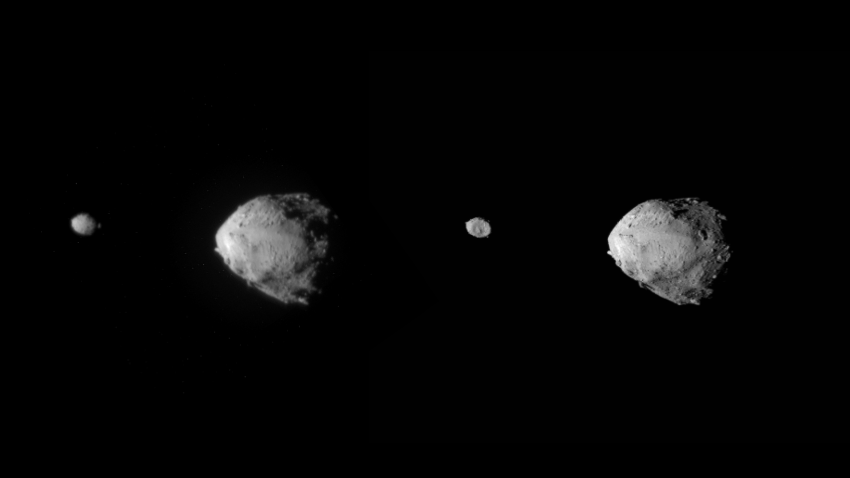
ESA’s Hera spacecraft has returned its first images of Dimorphos, the asteroid moonlet NASA’s DART probe struck in 2022, and they show the impact changed the small body far more than mission planners expected. Mission scientists presented the results at a press briefing at Berlin’s Natural History Museum. They reported three findings: Dimorphos has a new shape, a new rotation, and a retinue of previously unseen boulders traveling with it and its parent asteroid, Didymos.
A crater nearly as large as the moonlet
DART’s last images before impact showed Dimorphos as a rugby-ball-shaped body covered in large boulders. On the side that took the hit, the rounded face has been replaced by a wide crater. According to Sabina Raducan of the International Space Science Institute in Bern and the Freie Universität Brussels, it is almost as large as the moonlet itself. A central mound sits inside it, and an apparent cigar-shaped structure appears at the crater’s center. Little more can be said at the current image resolution.
Hera is orbiting the binary system at about 30 kilometers (20 miles), which gives a resolution of roughly 3 meters per pixel. The team expects to move closer over the coming months and hopes to reach at least 1 meter per pixel, according to Hera team scientist Naomi Murdoch of the Institut Supérieur de l’Aéronautique et de l’Espace in France.
The images indicate that Didymos itself looks unchanged, with the same boulder fields and equatorial ridge. The boulder-strewn hemisphere of Dimorphos that DART never imaged also appears unaltered.
A tumbling moon
Before the impact, Dimorphos was in synchronous rotation, turning once per orbit and keeping its long axis pointed at Didymos. That is no longer the case. Raducan said the moonlet now rotates chaotically, or tumbles, as it circles Didymos.
Because of this, scientists cannot yet predict which face Dimorphos will present at any moment. That complicates survey planning, but the team sees an advantage: the tumbling should expose every side of the body regardless of Hera’s trajectory.
Hundreds of unexpected companions
The most surprising result came from a stack of 11 observations. They show more than 100 meter-scale boulders, ranging from football-sized to washing-machine-sized, in orbit around the system. Didymos is about 700 meters across and Dimorphos about 150 meters.
The DART impact probably supplied many of these objects. It ejected a large amount of material from Dimorphos, and Earth-based telescopes saw much of it escape. Some fell back onto Dimorphos or Didymos, and some may still be in orbit. Secondary impacts of Dimorphos debris could also have launched boulders off Didymos. The team does not know whether any of the boulders were already orbiting before Hera arrived. DART passed at about 6 kilometers per second and could not have detected them, Raducan noted, because they show up only in multiple images and long exposures. She said the question may never be answered.
Navigation concerns
For engineers, the boulders are a hazard. Heli Greus, Hera’s Product Assurance and Safety Manager at ESA, described the discovery as a major shock and said the larger rocks could endanger both Hera and its CubeSats.
Claudia Balossi, Juventas CubeSat system engineer at Gomspace, said the CubeSats’ planned trajectories lie 2 to 3 kilometers from the system. The boulder cloud extends 7 to 10 kilometers, which puts the CubeSats within it. The team built in flexibility, however, and can adjust the trajectories based on what mission control learns in the coming months.
Source: skyandtelescope.org