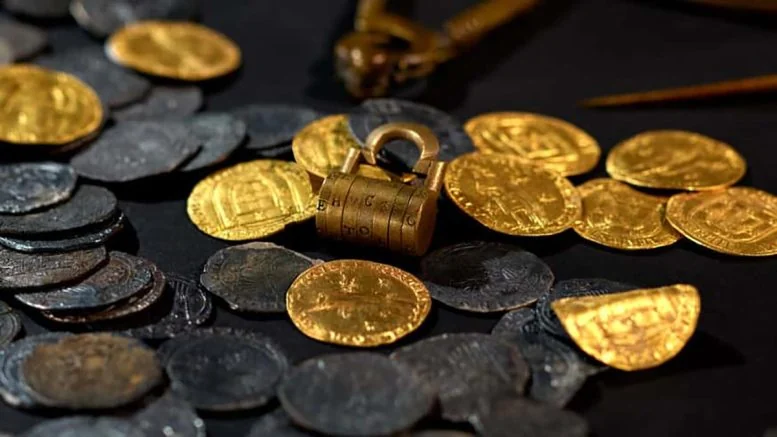
A brass combination lock recovered from a 16th-century shipwreck off the Welsh coast has been opened for the first time in more than 400 years, after researchers at Cardiff University used micro-CT X-ray imaging to work out its four-letter code without damaging it. The combination is ANCE.
The lock comes from the Ann Francis, which was returning from Spain when a ferocious storm blew it off course on the evening of December 28, 1583. The ship was wrecked on Margam Beach, near Port Talbot, and its cargo lay buried beneath the sand for centuries. The lock’s letter dials still turned, but nobody knew which four letters would release it.
A hoard uncovered over two decades
Dredging and storms eventually stripped away layers of sand and exposed traces of the sixteenth-century hoard. Metal detectorist Peter Hughes found most of the material over 21 years, between 1996 and 2017. The objects, recovered by Hughes and other detectorists, were later acquired by Amgueddfa Cymru (Museum Wales).
Hughes said he was struck by the quality of the workmanship and the lock’s condition when he found it, and was astonished that the ring dials moved easily after more than four centuries under the sand.
What the lock once secured is not known. Researchers believe it fastened a small chest holding valuables. Its position near a group of Spanish silver coins and two coin weights from the wreck offers some clues. It may have protected those items, or a chest containing things that did not survive, such as documents or textiles.
Micro-CT reveals the mechanism
Museum specialists worked with Cardiff University to examine the lock with micro-CT, an X-ray technique that captures fine internal detail. Dr. David Williams, a postdoctoral research associate at the Musculoskeletal Biomechanics Research Facility in the university’s School of Engineering, carried out the analysis. The facility normally uses the technology to study bones and other biological structures, and Williams said a 400-year-old padlock was a first.
The scan produced a detailed three-dimensional image of the internal mechanism. By seeing how the notches inside lined up with the letters on the dials, Williams identified the exact combination. He then passed it to the museum team, who tried it on the physical lock. It opened.
What the letters meant remains unknown
Alastair Willis, senior curator for numismatics and the Welsh economy at Amgueddfa Cymru, said Elizabethan combination locks are known in Britain. This one is distinctive, he noted, because of its exceptional condition and its link to a wreck with a firm date. Now that the code is known, he said, the open question is whether ANCE meant something to the person who set it.
The lock is on display at the National Waterfront Museum in Swansea alongside other Ann Francis finds, including rare gold coins from the reign of Ferdinand and Isabella of Spain and a boatswain’s whistle recovered from the wreck.
Source: scitechdaily.com