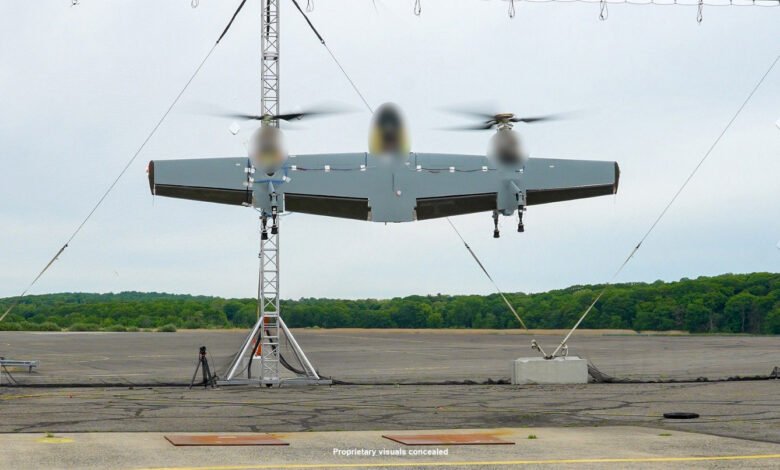
Sikorsky is flight testing a tail-sitting flying wing drone called Nomad that aims to pair the vertical takeoff and landing (VTOL) capability of a helicopter with the endurance of a fixed-wing aircraft. The Lockheed Martin-owned company is pitching the aircraft to U.S. military branches, the Department of Homeland Security, and forestry and civilian organizations.
Nomad is one of four prototypes still flying under DARPA’s $47 million EVADE program (Early VTOL Aircraft Demonstration). The program aims to demonstrate uses for unoccupied VTOL aircraft weighing up to 150 kilograms and to speed up their development. A fifth participant finished its flight tests in August.
EVADE targets and test cadence
Among the program’s goals is a 12-hour flight over a range of 23 kilometers with a 27-kg payload. DARPA has set no end date for testing. According to program manager Lt. Col. Phillip “Donna” Smith, a former U.S. Marine Corps Harrier pilot, each design keeps flying until it meets the milestones.
Smith described the approach as a continuous “fly, fix, fly” cycle. The companies test at their home sites, then travel to NAVAIR headquarters at Patuxent River, Maryland, to demonstrate their changes for DARPA before returning home to refine the design again. Once DARPA’s requirements are met, he said, further development of any aircraft will depend on customer demand.
The program’s priority is a faster route to initial deployment, partly by starting airworthiness certification while the drones are still in development. EVADE has also dropped, for now, a flight demonstration requirement for landing on a ship in rough seas, although the companies showed those capabilities in simulation. Smith called the base design a “pickup truck” version that customers could adapt, for example by swapping payload for fuel tanks or integrating a specific imager.
Nomad’s design
Igor Cherepinsky, director of Sikorsky’s VTOL technologies group, said Nomad builds on a tail-sitting flying wing concept the company first developed about 12 years ago with Lockheed Martin’s Skunk Works for DARPA’s VTOL X-plane program. That earlier aircraft weighed 4,500 kg and used turbine-driven rotors. Funding from Sikorsky and DARPA ran out before it was finished.
Nomad keeps the rotor-blown wing, in which air pushed over the wing by its two rotors augments lift. Sikorsky completed initial flight tests in July and then began the DARPA demonstrations. Between those sessions, the aircraft has been flying at the company’s Connecticut facility, where the aim is to reach progressively higher speeds. Cherepinsky said Sikorsky has also flown Nomad for potential customers, whom he would not name.
The main development challenge, he said, was the power plant. Engineers chose a hybrid arrangement in which a piston engine is boosted by an electric motor during hover. In horizontal cruise, the piston engine recharges the motor’s batteries. The transition between vertical and horizontal flight was also difficult, he said, and relies heavily on the control system.
Why the rotor-blown wing matters
Moble Benedict, an aerospace engineering professor at Texas A&M University who is not affiliated with Sikorsky and is familiar only with public information on Nomad, said the wing layout appears central to that transition. With nearly the whole wing in the rotors’ downwash, the airflow raises the wing’s effective airspeed. That lets it produce lift at a steep tilt, so the drone can transition at lower speeds. For a tail-sitter, he added, the downwash may also help in hover by partially deflecting horizontal gusts that would otherwise push on the wing like a sail.
Sikorsky says Nomad’s rotors are articulated. Benedict said that is key for a fixed-wing VTOL without a traditional tail. As on a helicopter, varying the blades’ angle of attack around their rotation can tilt the aircraft in hover and control pitch in forward flight.
The demand case
DARPA also asked participants to build aircraft that can handle rough conditions, such as landing on a pitching deck in 45-knot gusts or flying between buildings and through canyons, where swirling winds can flip a conventional VTOL drone. Smith said the difficulty is achieving both that resilience and long range.
U.S. Army Capt. Christopher Chelson of the Joint Readiness Training Center at Fort Polk, Louisiana, who is not affiliated with DARPA, Sikorsky or EVADE, said the immediate benefit of a hybrid design is payload. He said the Army will keep wanting VTOL capability for operating in constrained terrain, such as small clearings or spaces between buildings.
Source: aerospaceamerica.aiaa.org