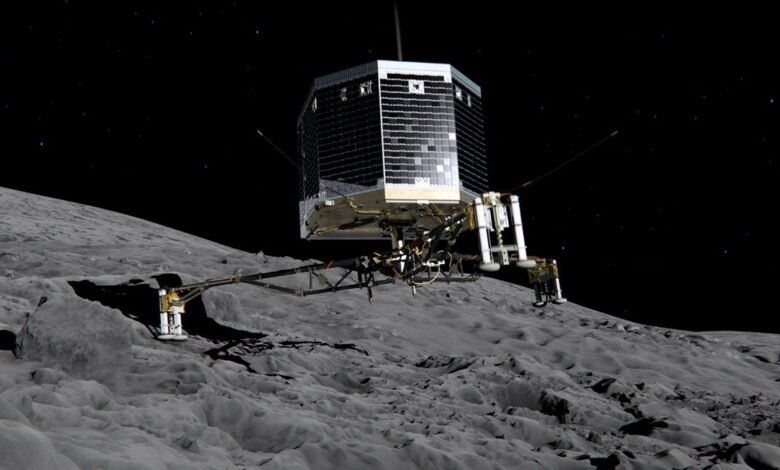
On Nov. 12, 2014, the European Space Agency’s Philae became the first spacecraft to soft-land on a comet, touching down on Comet 67P/Churyumov–Gerasimenko. The landing was far from clean. Philae bounced back into space after its first contact with the surface and touched down three separate times before coming to rest, an outcome that shaped how much science the lander could do and how long it stayed in contact with Earth.
A landing that did not go to plan
Philae separated from Rosetta, the ESA orbiter that had traveled to the comet, ahead of the descent. The lander was designed to anchor itself to the surface with harpoons, but they never fired. Without them, Philae rebounded on touchdown and rose roughly half a mile above the comet before the weak gravity pulled it back down.
The lander then drifted across the comet for about two hours and made a further bounce. Rosetta’s cameras lost track of it soon afterward. Scientists concluded that Philae had settled in a shaded spot where sunlight could not reach its solar panels, a serious problem for a solar-powered spacecraft that needs proper illumination to sustain operations.
Science on borrowed power
Philae still carried energy in its batteries, and they lasted more than two days on the surface. In that window the lander operated its 10 instruments. Its most notable result was the detection of organic molecules, which had never before been found on a comet.
The mission was designed to do two things: Rosetta would rendezvous with the comet and watch it change as it moved closer to the sun, and Philae would land on the icy, rocky surface to determine what a comet is made of. Rosetta succeeded in its part, and despite the rough landing, Philae returned data from the surface.
Finding the lost lander
Philae was missing for almost two years. Rosetta continued to orbit the comet until September 2016, and in that month its images revealed the lander lying on its side in a dark, rocky crevice on the rubber duck-shaped nucleus. The discovery came only weeks before Rosetta ended its own mission by landing on the comet on Sept. 30, 2016.
The images answered the question of where Philae had ended up and supported the earlier assessment that its resting place had limited the sunlight reaching it.
The Rosetta and Philae mission is still regarded as a first of its kind: a spacecraft that studied a comet from orbit and a lander that reached its surface, with the lander’s difficult touchdown forming part of that record.
Source: www.space.com