Astronomers using NASA’s Chandra X-ray Observatory have identified the likely cause of repeated outbursts from a massive, unstable star in another galaxy: a hidden companion, either a black hole or a neutron star, that strips material from the star every 113 days as the two orbit each other.
The study, published Monday in The Astrophysical Journal, is the first X-ray detection of this class of erupting star. It is also the first time one of these objects has been linked to a black hole or neutron star companion.
A star that keeps surviving
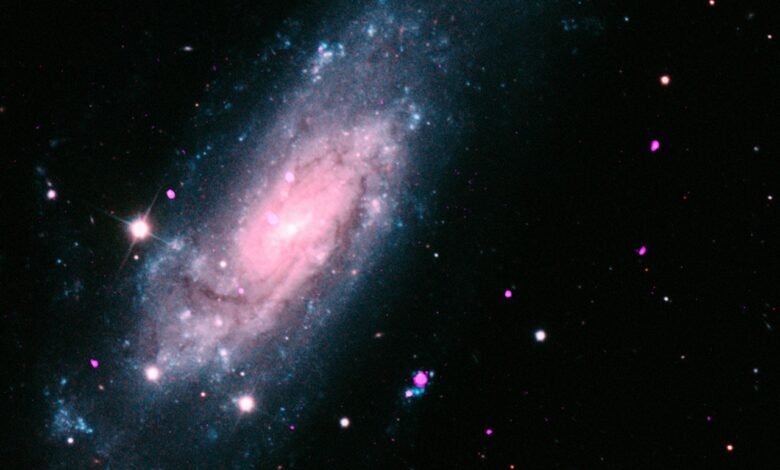
The star, designated AT 2016blu, lies in the spiral galaxy NGC 4559, about 30 million light-years from Earth. Astronomers estimate its mass at no less than 33 times that of the Sun. It is a luminous blue variable, a hot, massive star whose brightness changes over time. Eta Carinae is a better-known example of the type.
AT 2016blu belongs to a subset that brightens rapidly and repeatedly. The flares are intense enough to resemble supernovae, but the star is not destroyed, which is why such objects are called “supernova impostors.” Between 2012 and 2026, astronomers recorded at least 27 optical bursts from AT 2016blu, spaced roughly 113 days apart. Study lead Mojgan Aghakhanloo of the University of Virginia said astronomers had watched the star brighten and fade for 15 years without being able to explain it.
Timing the X-ray observations
Co-author Nathan Smith of the University of Arizona said the team suspected the optical flashes were powered by periodic bursts of high-energy X-rays, which heat the dense gas around the system and make it glow in visible light. That meant X-ray observations had to coincide with an optical outburst. Co-author Núria Torres-Albà, also of the University of Virginia, said the star’s survival of roughly three eruptions a year ruled out a true supernova and pointed the team toward X-ray data.
Chandra was the only X-ray telescope sharp enough to separate AT 2016blu from a nearby bright X-ray source. The optical monitoring came from the Katzman Automatic Imaging Telescope, the Las Cumbres Observatory Global Supernova Project, and the American Association of Variable Star Observers, including more than 30 amateur astronomers. When those observations showed the star in outburst in early 2026, a Chandra “Target of Opportunity” observation was triggered and carried out in March 2026.
The data showed AT 2016blu at least 100 times brighter in X-rays than in Chandra observations from 2001 to 2002, before the outbursts began. The best explanation is that material ejected by the star is captured by a neutron star or black hole when the two reach their closest approach in an oval-shaped orbit. The infalling material orbits at speeds approaching the speed of light and becomes hot enough to shine brightly in X-rays.
Links to ultra-luminous X-ray sources
The system is bright enough in X-rays to qualify as a candidate ultra-luminous X-ray source. These rare objects, found with telescopes such as Chandra, are not yet fully understood. Current thinking is that some contain neutron stars and others black holes. Because many of them vary sharply in X-ray brightness, the new result suggests a possible connection between such sources and violent stellar eruptions like those of AT 2016blu.
The finding may also inform studies of stars that vary in brightness before they explode as supernovae. Astronomers suspect much of that behavior comes from systems in which a massive star orbits a compact object or another massive star.
NASA’s Marshall Space Flight Center in Huntsville, Alabama, manages the Chandra program. The Smithsonian Astrophysical Observatory’s Chandra X-ray Center directs science operations from Cambridge, Massachusetts, and flight operations from Burlington, Massachusetts.
Source: science.nasa.gov