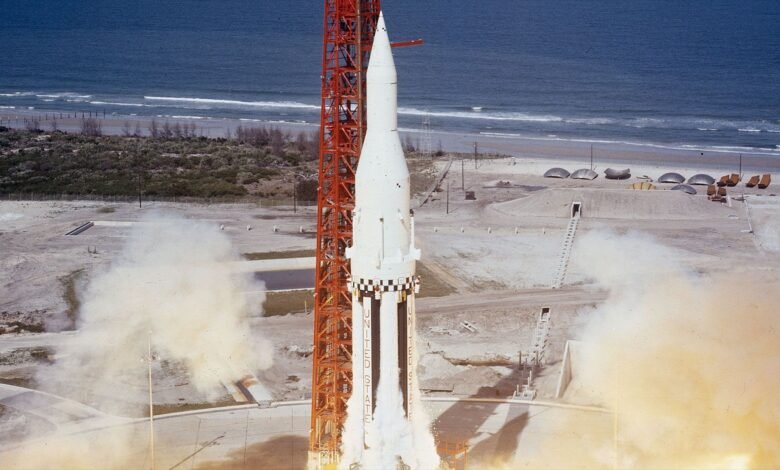
On Nov. 9, 1967, NASA launched the Saturn V rocket for the first time. The uncrewed flight, designated Apollo 4, was the first full test of the vehicle the agency had chosen to send astronauts to the moon. It was also the first launch from Launch Complex 39 at what is now Kennedy Space Center in Florida. By NASA’s account, it went according to plan.
A rocket taller than the Statue of Liberty
The Saturn V stood 363 feet (111 meters) tall, taller than the Statue of Liberty. It was the largest and most powerful rocket built up to that time, a record since passed by SpaceX’s Starship. It was a three-stage heavy-lift design, intended to carry a crewed capsule and a lunar lander to the moon and back.
Until Apollo 4, however, the rocket had never been tested as a complete vehicle. The pad was just as new. No rocket had flown from Launch Complex 39 before, and NASA built it specifically for the Apollo program. The site has since become the main departure point for orbital human spaceflight from the United States.
Shaking buildings miles away
The launch produced a powerful shockwave that surprised people watching nearby. The ground shook hard enough to rattle buildings miles from the pad, and the vibration sent dust and debris raining down across Kennedy Space Center.
The mission lasted 8 hours and 36 minutes. It ended when an uncrewed Apollo command module splashed down in the Pacific Ocean.
A test after tragedy
The flight came at a difficult moment for NASA. On Jan. 27, 1967, the Apollo 1 crew of Gus Grissom, Ed White and Roger Chaffee died when a fire broke out inside their command module during a ground test on the launch pad.
Against that backdrop, the Apollo 4 result carried weight. Wernher von Braun, then director of NASA’s Marshall Space Flight Center in Huntsville, Alabama, described the launch as virtually flawless, noting that liftoff came exactly on time and that every stage performed as intended. George Mueller, NASA’s associate administrator for manned space flight, said the debut flight greatly strengthened national confidence in how the agency was managing what he called the largest research and development effort the western world had undertaken.
The road to the moon
The Saturn V’s record after Apollo 4 was rapid. One year later, a Saturn V launched the first astronauts toward the moon on Apollo 8. Every later Apollo mission flew on the same rocket. In July 1969, less than two years after its debut, a Saturn V sent the Apollo 11 crew on the first crewed lunar landing mission.
Source: www.space.com