On November 16, 1974, astronomers using the Arecibo radio telescope in Puerto Rico transmitted the first intentional radio signal aimed at space. It was the most powerful broadcast deliberately sent outward at the time. The astronomers described the goal as making contact with extraterrestrial life, and the transmission divided opinion from the start.
A message built from binary
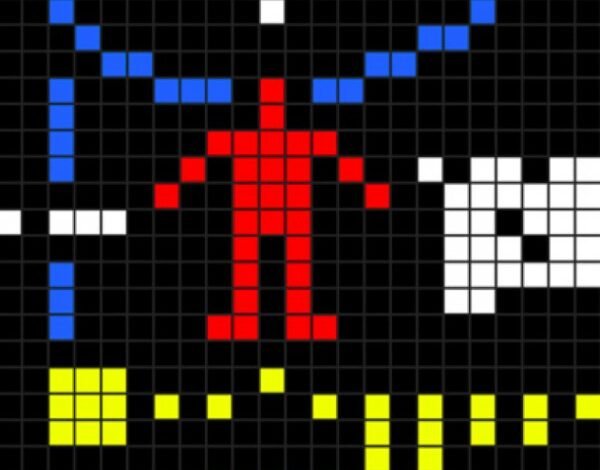
Cornell astronomy professor Frank Drake designed the message with input from other scientists, including Carl Sagan. The result was a short, simple pattern of binary numbers. Encoded in it were the basic chemical elements of life, the structure of DNA, Earth’s position in the solar system and a stick figure of a human.
Sending it took about three minutes. The message totaled 1,679 bits, a rate far slower than any modern computer modem.
Power, direction and distance
The signal’s strength came from Arecibo’s megawatt transmitter paired with its 1,000-foot (305-meter) antenna, which concentrated the energy into a very small patch of sky. According to the SETI Institute, the emission was equivalent to a 20-trillion-watt omnidirectional broadcast. A SETI experiment using a receiving antenna similar in size to Arecibo’s could detect it almost anywhere in the galaxy.
The target was M13, a globular star cluster orbiting the center of the Milky Way. It was chosen because it holds a large number of stars and was in the sky at the time and place of the ceremony. M13 lies about 25,000 light-years from Earth, so the signal has a very long way to go. It has now traveled about 52 light-years.
A divided reaction
Some people welcomed the broadcast as a reminder that Earth is probably not the only planet in the Milky Way where intelligent life has evolved. Others argued that if other civilizations exist, humanity should not draw attention to itself. The question of whether to advertise our presence in space remains unresolved.
Arecibo’s end
The telescope that sent the message is no longer operational. In 2020, its 900-ton receiver platform came loose from its cables and fell onto the reflector dish more than 400 feet (120 meters) below. Video of the collapse was widely circulated. The 1974 transmission remains one of the observatory’s best-known achievements.
Source: earthsky.org