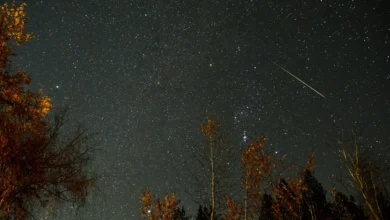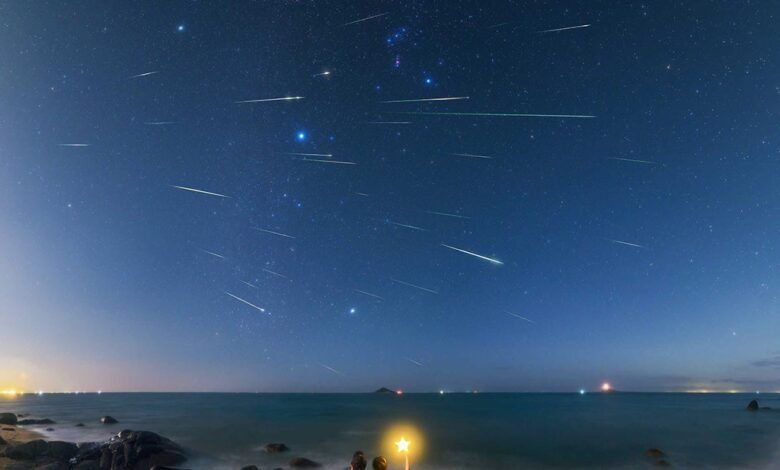
A composite photograph of the 2022 Leonid meteor shower, taken from Hainan, China, shows how observers can approach a meteor shower: watch a wide stretch of dark sky and accept that no one can say where the next meteor will appear. The Leonids peak in mid-November every year.
A composite built from hours of exposure
The image looks out over the South China Sea. It is a composite. The meteor streaks were recorded over a period of a few hours, then isolated and added to a foreground image captured earlier. The result shows many meteors at once, though they did not all appear in the same moment.
The streaks diverge from the direction of the constellation Leo, the radiant from which the shower takes its name. In this frame they cross the constellation Orion. Mars appears as a bright red point near the top of the image.
Watching a shower that cannot be predicted
Even during an active shower, there is no practical way to know in advance where a given meteor will show up. For that reason, the most effective approach is to settle into a comfortable spot and take in as much of the dark sky as possible rather than fixing on a single point. The source notes that sharing the experience with a friend can add to the enjoyment.
The photograph also has a human side. It shows two meteor enthusiasts celebrating a shared birthday that month. They had bonded over their interest in astronomy and were later married.
The Leonids return each year around mid-November, giving observers another opportunity to try this kind of wide-field sky watching.
Source: science.nasa.gov